The numbers are brutal.
Approximately 80 percent of AI startup ideas launched between 2023 and 2025 are on track to shut down by the end of 2026 — and the pattern is accelerating. If you are evaluating AI startup ideas 2026, these numbers are not a prediction from a pessimist. That is not a prediction from a pessimist. That is the pattern emerging from over 319 documented AI startup failures analyzed by IdeaProof, BuildMVPFast, and multiple investor post-mortems published this year.
Here is what makes this wave different from previous startup crashes. These are not failing because of bad execution. They are failing because the idea itself had no foundation. Founders built fast, raised money, launched products, and then watched OpenAI ship the exact same feature natively — for free.
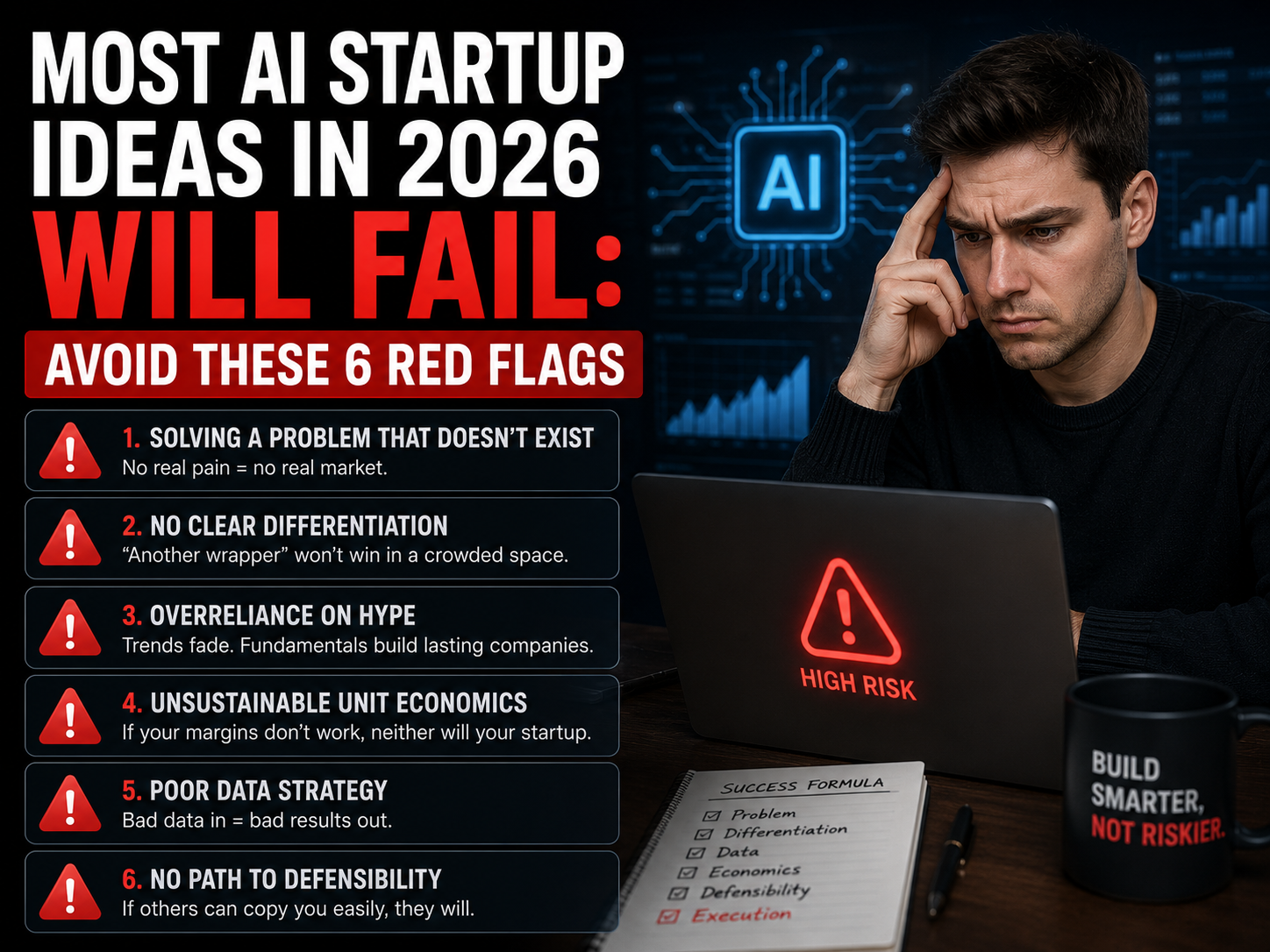
Before you spend a rupee building your AI startup idea, run it through these six red flags. If your idea fails even one of them, stop.
Red Flag 1: Your Entire Product Is a Wrapper Around One AI Model
This is the most common and most fatal mistake of the 2023 to 2026 AI era.
A wrapper startup takes an existing AI model — GPT-4, Claude, Gemini — adds a user interface, maybe a custom prompt, and calls itself a product. For a brief period in 2023, this worked. The technology was new, users were confused, and a simple interface that made ChatGPT easier to use had genuine value.
That window closed.
Google’s VP of Product warned publicly in February 2026 that two categories of AI startup will not survive: those with no proprietary data and those whose only value is making an existing model easier to use. OpenAI’s own product roadmap cannibalized at least 200 funded wrapper startups in 2024 alone just by adding features.
Ask yourself: if OpenAI or Anthropic adds a native version of your feature tomorrow, does your company still exist? If the answer is no, you are building a wrapper.
Red Flag 2: Your Moat Is a Prompt
Prompt engineering was genuinely hard in 2022. It is a commodity skill in 2026.
If the only thing separating your product from a user typing directly into ChatGPT is a well-crafted system prompt, you do not have a defensible business. Prompts cannot be patented, trademarked, or protected in any meaningful way. A competitor can reverse-engineer your output in an afternoon.
Real moats in AI look like proprietary training data, network effects from user-generated data, deep workflow integrations that create switching costs, or exclusive data partnerships. If your only answer to “what stops someone from copying this?” is “our prompts are really good,” that is not a moat. That is a head start measured in weeks.
Want to stay ahead of every AI startup trend before it goes mainstream? 👉 Follow Startup Pill for weekly founder intelligence
Red Flag 3: Your AI Startup Ideas 2026 Disappear When the Model Gets Smarter
Humane burned $241 million dollars building an AI pin that became obsolete before it shipped at scale because every function it performed was absorbed by smartphone AI assistants.
Builder.ai raised $445 million and was exposed for using 700 human engineers while claiming AI-powered code generation. The model they were pretending to use eventually did what they promised — and exposed them in the process.
The question to ask: does my startup become more valuable or less valuable as the underlying AI models improve? If your product depends on the AI being slightly limited so that your layer adds value, you are building on a foundation that is actively shrinking beneath you.
Startups that survive this cycle own something the model cannot absorb: proprietary data, customer relationships, regulatory compliance positioning, or a physical integration.
Red Flag 4: You Are Solving a Problem Nobody Pays For
AI makes it dangerously easy to build solutions to problems that feel real but generate zero revenue.
The classic trap: you identify something genuinely annoying, build an AI tool that fixes it, and discover that nobody will pay more than zero rupees to solve it because they were already tolerating it for free.
Before writing a line of code, find five people who have this problem and ask them one question: what are you currently spending money on to solve this? If the answer is nothing, you do not have a paying customer problem. You have a free-time problem — and AI cannot monetize those.
The AI startups generating real revenue in 2026 are attacking problems that businesses already have budget lines for: legal compliance, customer service costs, medical documentation, financial reconciliation. Find the existing budget. Then replace what it is currently paying for.
Red Flag 5: Your Target Customer Is “Everyone Who Uses AI”
This is a market sizing problem disguised as ambition.
When a founder says their product is for “anyone who wants to use AI more effectively” or “all knowledge workers,” what they are actually saying is that they have no specific customer. And a product built for everyone is optimized for no one.
The AI startups winning in 2026 are ruthlessly vertical. They build for one job title at one company size in one industry. A contract review tool for Series A startup legal teams. An inventory forecasting tool for D2C fashion brands under five crore revenue. A patient intake assistant for single-doctor clinics in Tier 2 cities.
Narrow your customer definition until it feels uncomfortably specific. That specificity is what makes your product irreplaceable rather than interchangeable.
The best startup ideas come from obsessing over one customer’s exact pain. 👉 Discover more at Startup Pill
Red Flag 6: Your Business Only Works If the AI Is Perfect
This is the least obvious red flag and the one that kills the most well-intentioned founders.
AI makes mistakes. Every model hallucinates, misclassifies, or generates outputs that are wrong in ways that matter. If your product requires the AI to be correct 99 percent of the time and the model is currently accurate 91 percent of the time, you do not have a product problem — you have a physics problem.
Forward Health promised 3,200 AI health kiosks and shipped 5 because the accuracy requirements for medical-grade AI diagnostics did not match the actual capability of available models.
Design your business assuming the AI will sometimes be wrong. Build human review layers. Create confidence thresholds. Charge for the human-AI combination, not the AI alone. The founders who survive this era treat AI as a powerful assistant that needs supervision, not a perfect oracle that can run unsupervised.
The Filter: 6 Questions Before You Build
Run your AI startup idea through these six questions before spending anything.
What happens to my business the day OpenAI ships this as a native feature? What proprietary data or integration do I own that cannot be copied in a week? Does my target customer currently spend real money solving this problem? Can I name exactly who my first 10 paying customers are and where to find them? Does my business model account for AI errors, or does it assume perfection? Would my startup become more or less valuable as models get ten times smarter?
If you can answer all six confidently, you may have a real AI startup idea in 2026.
If you cannot, you have saved yourself several lakhs and several years of your life. That is the filter. Use it.
FAQ — AI Startup Ideas 2026
Why are most AI startups failing in 2026?
Most AI startups in 2026 are failing because they built thin wrappers around existing AI models with no proprietary data, no defensible moat, and no specific customer segment. When foundation model companies ship native versions of those features, the startups have nothing left to sell.
What is an AI wrapper startup?
An AI wrapper startup is a company whose entire product is a user interface built on top of an existing AI model like GPT-4 or Claude, with no proprietary data, unique integrations, or technical differentiation. These startups are at extreme risk of being made obsolete when the underlying model adds the same functionality natively.
How do I validate an AI startup idea before building?
Validate by finding five people with the specific problem, confirming they currently spend money solving it, identifying what makes your solution impossible to replicate with a simple API call, and stress-testing whether your business survives if the underlying AI model improves significantly.
What AI startup ideas actually work in 2026?
AI startups with real traction in 2026 own proprietary industry data, serve a highly specific customer segment, integrate deeply into existing workflows, and provide value even when the AI model makes occasional errors. Vertical AI with real data moats survives. Horizontal wrappers do not.
How much does it cost to start an AI startup in India?
The real cost of starting an AI startup in India is not the API fees — it is the months spent building something nobody wants. Founders can access most AI models for under ₹10,000 per month at prototype stage. The expensive mistake is scaling a product before validating that someone will pay for it.