Table of Contents
Green hiring is no longer a buzzword that lives inside glossy corporate reports. It has evolved into a global talent movement that is reshaping industries, job descriptions, and workforce strategies from the ground up. The shift is so vast that whether you live in Mumbai, Melbourne, Nairobi, or New York, you’re already seeing its impact. And if you aren’t, your competitors probably are.
Today’s companies are no longer asking
“Do we need sustainability talent?”
They’re asking
“How fast can we hire, train, and reorganize around it?”
That urgency is driven by regulation, investor expectations, rising climate risks, and a new generation of workers who care deeply about purpose. In this new era, green hiring is becoming the backbone of business resilience.
This article dives into what green hiring really means, why it is sweeping across continents, which skills matter most, and how leaders can build a sustainability-ready workforce that is capable of surviving and winning in a climate-driven economy.
What Exactly Is Green Hiring?
In simple terms, green hiring means recruiting people who can help a company grow without harming the planet.
Think of it as the talent strategy behind sustainability. It’s not just about hiring environmental scientists or solar engineers. It’s about embedding climate competence into every function:
• A finance professional who understands climate risk.
• A supply chain manager who can transition to circular sourcing.
• A designer who creates products with low carbon footprints.
• A data analyst who can calculate emissions and energy waste.
• A marketing leader who communicates sustainability transparently.
The world is hiring for people who can think sustainably — not as an add-on, but as a core competency.
Why the World Is Suddenly Hyper-Focused on Green Hiring
1. Chart: Projected Green Jobs Growth by Region (2025–2030)
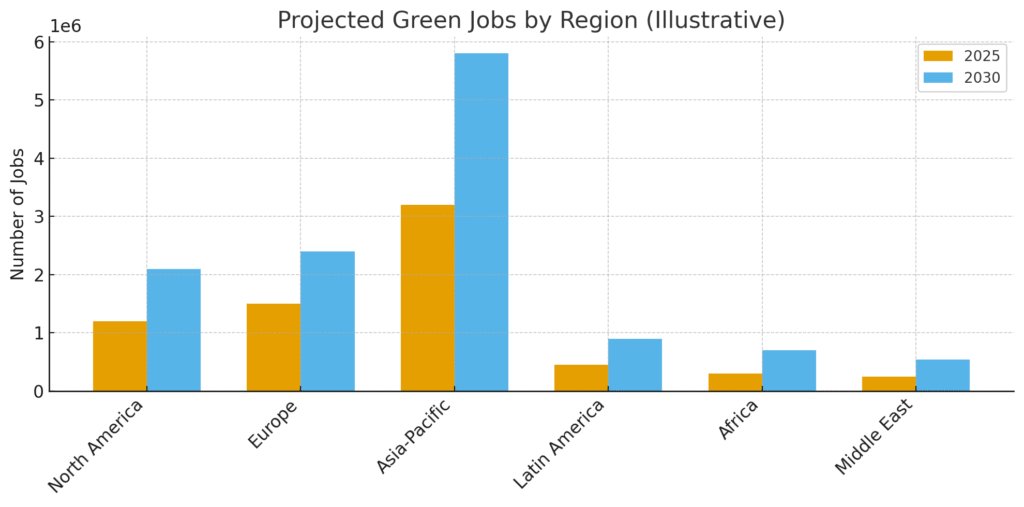
There are four forces reshaping the global hiring landscape:
1. Regulation is rising — everywhere
The EU Green Deal. SEC climate disclosures. Canada’s zero-emission mandates. Australia’s climate reporting rules. Gulf nations’ clean-tech investments. Southeast Asia’s renewable push.
Regulation is no longer a regional phenomenon. It is global — and companies need people to comply.
2. Investors demand climate accountability
Markets reward climate-ready companies. Asset managers are shifting capital toward low-carbon operations. Boards are pushing CEOs to demonstrate sustainability readiness through talent.
3. Customers prefer responsible brands
From food to fashion to fintech, buyers across continents choose brands that are transparent and responsible. Green talent ensures companies can deliver on those promises.
4. Employees want purpose
Gen Z and millennials — who make up over half of the global workforce — rank “environmental responsibility” as a top employer expectation.
If you don’t hire green talent, you lose talent. It’s that simple.
Real Story: A Shift I Witnessed First-Hand
Two years ago, a mid-size logistics company approached me because clients were asking for emissions reporting. They didn’t know where to start. Within 18 months they:
• Hired a carbon analyst
• Upgraded their operations team with green-skills training
• Reduced fuel waste by 11 percent
• Secured three new international contracts
What changed? Not their fleet. Their talent.
Green hiring is not a trend; it’s an operational accelerator.
The Skills the World Is Fighting For
Green hiring is often misunderstood as purely environmental. In reality, the most in-demand skills are hybrid ones.
Top Sustainability-Ready Skills:
Climate Literacy:
Understanding emissions, circularity, net-zero pathways, and climate models.
Data & Analytics:
Carbon accounting, energy dashboards, lifecycle analysis, AI-driven resource planning.
Operational Optimization:
Reducing waste, energy efficiency, circular logistics.
Policy & Governance:
ESG reporting, global standards, compliance frameworks.
Tech-Integrated Sustainability:
IoT energy automation, clean-tech integration, AI-driven climate tools.
Behavioural Change Expertise:
Convincing teams, customers, and suppliers to adopt sustainable practices.
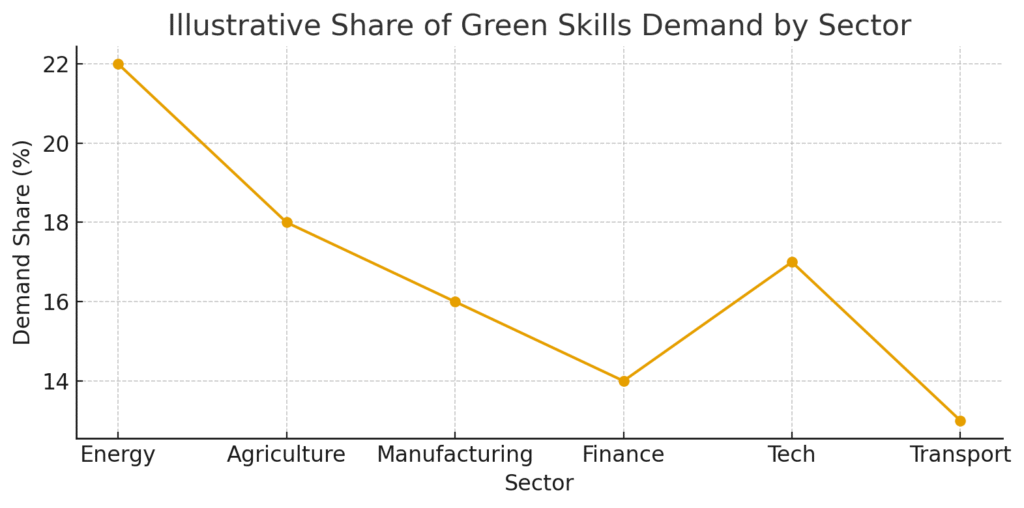
2. Chart: Green Skills Demand by Sector
The X + Green Formula
This is the future hiring model I see gaining global traction:
Role X (your core job) + Green (sustainability layer added)
- Finance + Green → Climate Risk Analyst
- HR + Green → Sustainability Culture Lead
- Ops + Green → Resource Efficiency Manager
- Marketing + Green → Sustainable Brand Storyteller
- IT + Green → Clean-Tech System Architect
This hybrid skill model will dominate global hiring in the next decade.
Sectors Leading the Green Hiring Revolution
1. Energy & Renewables
Solar, wind, hydrogen, and grid modernization roles are exploding.
2. Manufacturing & Industrial
Process engineers, circular manufacturing specialists, and clean-tech automation experts are in demand.
3. Finance
Banks, insurers, and asset managers are hiring climate analysts, ESG auditors, and carbon-pricing experts.
4. Agriculture & Food Systems
Climate-adaptive farming, regenerative agriculture, and supply-chain sustainability roles.
5. Technology
Big tech is hiring sustainability data scientists, environmental ML engineers, and AI-for-climate researchers.
The Business Playbook: How Companies Build a Sustainability-Ready Workforce
Step 1: Make sustainability a leadership KPI
If the C-suite doesn’t own it, hiring won’t scale.
Step 2: Map sustainability to business outcomes
Avoid the common mistake of “passion hires.” Focus on roles that affect revenue, efficiency, or compliance.
Step 3: Redesign job descriptions
Every function should include a sustainability angle — not just the ESG team.
Step 4: Launch internal upskilling programs
Micro-certifications, on-the-job green projects, and cross-functional rotations work best.
Step 5: Build partnerships with universities and clean-tech hubs
This supports talent pipelines and innovation alignment.
Step 6: Measure and reward green outcomes
Tie bonuses to measurable sustainability wins:
- Energy saved
- Emissions reduced
- Waste minimized
- Compliance achieved
Table: Sample Green Competency Mapping by Role
| Role | Green Competency | Business Impact |
|---|---|---|
| Procurement Lead | Circular supplier selection | Lower material costs |
| Finance Controller | Carbon reporting | Improved investor trust |
| HR Director | Sustainability culture programs | Higher retention |
| Product Designer | Low-carbon design | Premium market positioning |
| Operations Manager | Energy efficiency | Lower operational costs |
Most Asked Question
1. What is green hiring?
Recruiting people with skills to help organizations reduce environmental impact and meet climate goals.
2. Which industries hire for green skills?
Energy, manufacturing, finance, agriculture, logistics, and technology.
3. Do green jobs require special degrees?
Not always. Many roles only need sustainability training layered onto existing skills.
4. Are green roles high-paying?
Yes. Roles like carbon analyst, clean-tech engineer, and ESG auditor command premium salaries globally.
5. How do I transition into a green career?
Start with climate literacy, build technical skills aligned to your function, and gain practical project experience.
6. How should companies measure green hiring success?
Outcomes like emissions reduction, cost savings, compliance milestones, and innovation contributions.
7. Which certifications matter?
GHG Protocol, ESG Reporting, LEED, renewable energy certifications, and climate-risk finance programs.
Why Green Hiring is Now a Global Imperative
The companies that thrive in the next decade will be those that treat sustainability not as a department but as a talent strategy. Green hiring creates resilience, unlocks new markets, strengthens brand trust, and positions organizations for the realities of a climate-driven economy. Whether you’re a leader, a professional, or a job-seeker, embracing this shift isn’t optional anymore — it’s the new currency of global competitiveness. source
And the world is hiring. The question is whether companies and professionals are ready.
Stay ahead of the world’s fastest-moving startup trends. Get sharp insights, founder playbooks, and sustainability-driven strategies directly from Startup Pill. If you want your startup to win in a climate-conscious market, this is the place to be.
Follow Startup Pill and lead the future of green innovation.