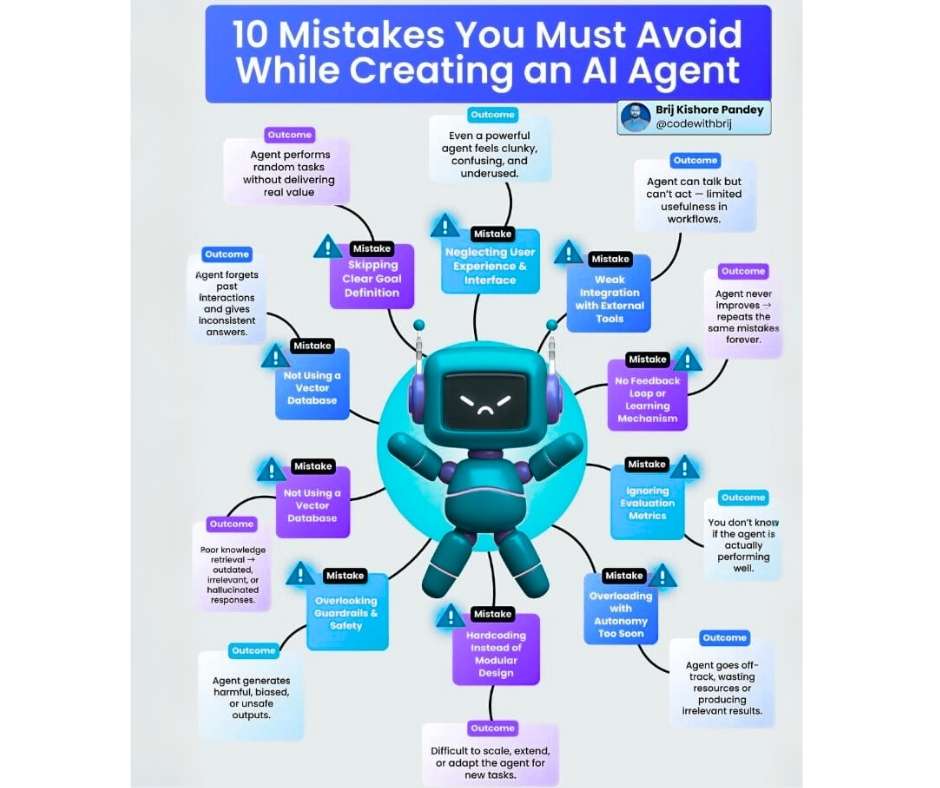

Creating an AI agent in 2025 is one of the most exciting opportunities for startups, freelancers, and Gen Z innovators. But many projects fail because of avoidable mistakes. Below, I’ll break down the 10 hidden mistakes and how to fix them with automation and best practices.
Mistake #1: Ignoring Data Quality
Poor data is the biggest silent killer of AI agents. If your dataset contains errors, duplicate entries, or biased samples, your AI agent will deliver flawed results. Over time, this builds mistrust with users.
Fix: Automate data cleaning with tools like OpenRefine or Pandas profiling scripts. Integrate validation pipelines before training.
Why it matters: A bad AI agent isn’t just “wrong”—it destroys brand trust faster than anything.
Mistake #2: Overcomplicating the Model
Many developers think a bigger model equals better performance. In reality, overly complex models drain resources and introduce inefficiency.
Fix: Start small. Use lightweight frameworks like LangChain + GPT-4-mini or Llama-Index for quick deployment. Automate scalability only if demand grows.
Why it matters: Simplicity often beats complexity. A lean AI agent adapts faster to real-world use.
Mistake #3: Skipping Human-in-the-Loop Validation
Fully automated agents without human oversight often make embarrassing mistakes—sending wrong emails, approving false reports, or hallucinating facts.
Fix: Automate checkpoints where human feedback is required. Use Feedback APIs or Reinforcement Learning with Human Feedback (RLHF) workflows.
Why it matters: The best AI agents feel “trustworthy” because they blend machine efficiency with human judgment.
Mistake #4: Neglecting Security & Compliance
AI agents often handle sensitive data like emails, contracts, or health info. If you skip security, you risk breaches and legal action.
Fix: Automate encryption, access controls, and compliance monitoring with tools like Vanta or OneTrust AI compliance checks.
Why it matters: A single data leak can bankrupt a startup and destroy user trust.
Mistake #5: Lack of Explainability
An AI agent that gives answers without showing reasoning frustrates users. Lack of transparency makes it look like a “black box.”
Fix: Use explainability frameworks like SHAP or LIME. Automate “reasoning steps” for user-facing answers.
Why it matters: People trust what they can understand. Transparency drives adoption.
Mistake #6: Over-Promising AI Capabilities
Startups often market their AI agent as “human-level” or “100% accurate.” Unrealistic claims backfire quickly when results fall short.
Fix: Automate realistic demos with sandbox test cases. Show real limitations.
Why it matters: Honesty builds long-term credibility; hype burns it down.
Mistake #7: Forgetting Edge Case Scenarios
AI agents may work well in standard cases but fail in unexpected situations, like slang queries, multi-language input, or extreme values.
Fix: Automate stress testing with synthetic data and fuzzing tools.
Why it matters: If your AI fails at the edge, users will remember the failure—not the 95% success.
Mistake #8: Failing to Optimize for Cost
Running AI agents without monitoring usage often leads to skyrocketing bills. Many teams run 10x more inference than needed.
Fix: Automate usage monitoring with Weights & Biases, Comet, or Prometheus dashboards. Use caching layers to save costs.
Why it matters: Investors and founders alike care about ROI. Cost-bloated AI agents won’t survive.
Mistake #9: Ignoring User Experience (UX)
Even the smartest AI agent will fail if the interface is clunky. Users want smooth conversations, not frustrating forms.
Fix: Automate usability testing with Hotjar or PlaybookUX. Integrate AI-driven UX analytics to optimize flow.
Why it matters: A poor UX feels like wasted potential. Good UX makes AI “invisible” but powerful.
Mistake #10: No Continuous Learning System
Static AI agents quickly become outdated. Without feedback loops, they stop improving and fall behind competitors.
Fix: Automate continuous fine-tuning pipelines. Collect user feedback with lightweight prompts, and retrain periodically.
Why it matters: AI agents should grow smarter, not stale. Continuous learning ensures survival.
SOURCE-For more insights on responsible AI development, explore Stanford’s AI Index Report 2025.
Bonus: 5 AI Prompts for Image & Graphic Generation
To make your AI agent project more engaging, here are 5 prompts you can try with Google Banana, MidJourney, or DALL·E:
- AI Agent at Work
“A futuristic AI assistant collaborating with a young professional in a startup office, holographic dashboards glowing, photorealistic style.” - Mistakes in Action
“A robot holding a signboard with ‘Data Bias’ and ‘High Costs’ in neon letters, crossroads setting, cinematic atmosphere.” - AI Workflow Visualization
“A clean flat-design infographic of an AI workflow: input, training, validation, output — bright vector style.” - The Future of Gen Z + AI
“Gen Z freelancer in 2025 working side by side with a holographic AI assistant, neon cityscape, ultramodern look.” - AI Security Shield
“A glowing digital shield protecting a neural network brain, symbolizing AI safety and trust, futuristic vector design.”
At Startupill, we don’t just talk about AI trends—we break them down into practical guides and tools you can use today. If you’re building your first AI agent, avoid these 10 mistakes and start strong.
Follow Startupill for more practical startup ideas, AI insights, and business strategies.