Why 2026 Is a Defining Year for SaaS Founders
2026 is not just another year in the SaaS cycle. It is a structural reset. Buyer behavior has matured. AI has collapsed time-to-market. Capital is more selective, and distribution is now more valuable than product features. For founders, this creates pressure but also asymmetric opportunity.
Table of Contents
If you are building a SaaS platform in 2026, the old playbooks no longer work. The winners will not be those who simply launch faster, but those who design for trust, retention, and exit optionality from day one.
This roadmap is written for founders who want clarity. Not hype. Not theory. A practical, founder-first SaaS roadmap that shows how to build, scale, and sell a SaaS company in 2026.
Phase 1: Market Intelligence Before Code
Most SaaS failures in 2026 will not come from poor engineering. They will come from shallow market understanding.
Before writing a single line of code, founders must answer three non-negotiable questions.
Who is the buyer with budget authority?
What workflow are they emotionally frustrated with?
What outcome do they want faster, cheaper, or with less risk?
In 2026, vertical SaaS continues to outperform horizontal tools. Founders targeting healthcare operations, compliance, fintech infrastructure, HR automation, climate reporting, or creator monetization are seeing stronger willingness to pay.
This is also where global thinking matters. SaaS products built in India or emerging markets are now selling globally from day one. Pricing, UX language, and compliance must be international from the start.
Phase 2: Product Strategy Built for Speed and Proof
In 2026, SaaS MVPs are no longer minimal. They are opinionated.
Thanks to AI-assisted development, no-code, low-code, and wipecoding platforms, founders can reach functional MVPs in weeks, not months. The advantage is not speed alone. The advantage is validation velocity.
Your first version must do one thing exceptionally well. Not five things adequately.
Successful SaaS startups in 2026 are prioritizing:
Clear onboarding with time-to-value under ten minutes
One core metric that proves ROI
Native integrations instead of feature bloat
AI is not a feature anymore. It is infrastructure. Whether you use it for onboarding, analytics, support, or automation, users expect intelligence by default.
Phase 3: Go-To-Market Is the Real Product
In 2026, distribution is the moat.
The biggest SaaS exits are not happening because of superior technology. They are happening because founders cracked one repeatable acquisition channel.
Winning go-to-market strategies include:
SEO-first SaaS with high-intent problem keywords
Founder-led LinkedIn distribution
Product-led growth with freemium or trial loops
Strategic partnerships with platforms or marketplaces
Startupbuild.com should note this clearly. SaaS founders who invest early in content, search visibility, and thought leadership create compounding growth assets.
Paid ads are harder. Trust is more expensive. Organic authority is the long game that wins.
Phase 4: Monetization and Pricing in 2026
Pricing is strategy, not math.
In 2026, buyers are pushing back on flat subscriptions. Usage-based pricing, outcome-based pricing, and tiered enterprise models are gaining traction.
Founders must align pricing with value moments.
If your SaaS saves time, price per seat.
If it saves money, price per volume.
If it drives revenue, price per outcome.
The goal is not higher ARPU. The goal is lower churn with predictable expansion.
Phase 5: Scaling Operations Without Breaking Culture
Once product-market fit is visible, scale becomes dangerous if unmanaged.
Founders scaling SaaS companies in 2026 must build systems, not heroics.
This includes:
Async-first teams
Documentation-driven operations
Customer success as a revenue function
AI-assisted support and QA
Global talent is now the norm. Indian SaaS founders are hiring in Eastern Europe, Southeast Asia, and Latin America to stay lean and competitive.
Phase 6: Fundraising Strategy or Bootstrapped Control
Capital in 2026 is cautious but available.
VCs are backing SaaS startups with clear revenue, low churn, and distribution leverage. Decks without traction are ignored.
However, many founders are choosing a different path. Bootstrapped SaaS with profitability and audience ownership is becoming a premium acquisition target.
The key is optionality. Build a business that can raise, but does not need to.
Phase 7: Designing Your SaaS for Acquisition
The best time to plan your exit is before you scale.
Buyers in 2026 are looking for:
Clean financials
Low customer concentration
Strong SEO or owned audience
Defensible niche positioning
Whether you sell to a strategic buyer, private equity firm, or through a marketplace, your SaaS must look stable, predictable, and scalable.
Founders who document processes and reduce dependency on themselves command higher multiples.
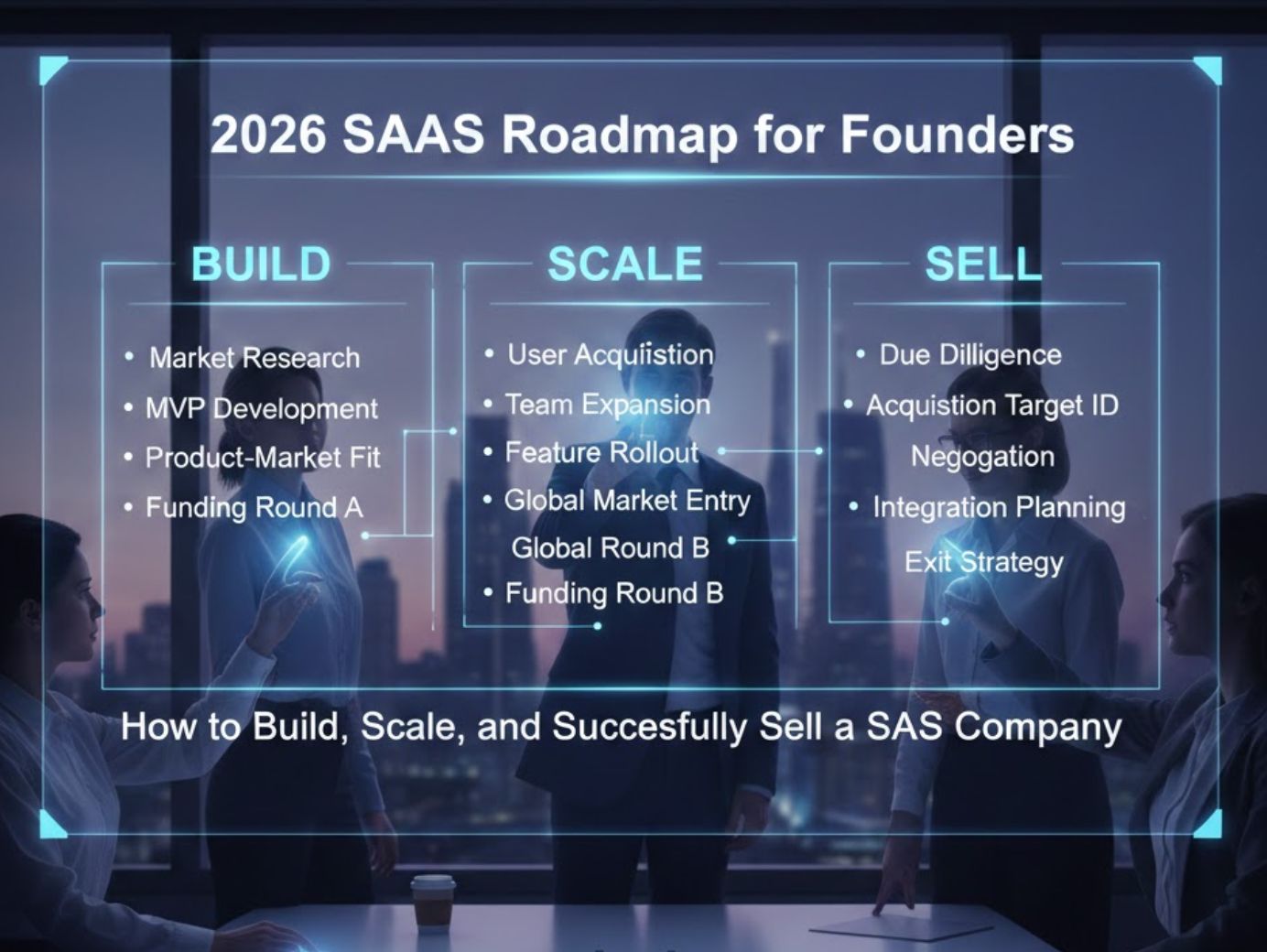
The 2026 SaaS Roadmap: How to Build, Scale, and Successfully Sell a SaaS Company
A Founder-First Playbook with Real Tools, Real Decisions, and Zero Fluff
If you are building a SaaS company heading into 2026, the rules have changed. Capital is no longer cheap, AI is no longer optional, and product-led growth is no longer automatic. Buyers are more cautious, churn is more brutal, and differentiation is harder than ever.
Paradoxically, this is also one of the best moments in history to build a SaaS company—if you know exactly what to build, how to scale it, and how to design for an eventual exit. This is not another trends list. This is a practical, phase‑by‑phase SaaS roadmap for founders who want to build something valuable, defensible, and sellable.
Why 2026 Is a Make-or-Break Year for SaaS Founders
The SaaS industry is entering a maturity phase. AI and no‑code have flattened technical barriers and reduced build time dramatically, while customer expectations for speed, intelligence, security and ROI continue to rise. In many categories, “good enough” software is now the default; buyers expect clear outcomes, not just features.
In 2026, the winners will not be the loudest or the fastest—they will be the most operationally disciplined. Founders who win will:
- Build narrowly, not broadly.
- Monetise intelligently, not emotionally.
- Use AI as leverage, not decoration.
- Design their company for acquisition long before they need one.
The roadmap below reflects that reality, broken into three founder phases: Build, Scale, and Sell.
Phase 1: Build — From Zero to a Real Product (0 to First 100 Customers)
Objective: Validate demand, reach activation, and prove that your product solves a painful, repeatable problem.
Founder mindset: Speed over polish. Learning over revenue. Focus over ambition.
What You Are Actually Building in Phase 1
You are not building a platform or “the future of X.” You are building one critical workflow that delivers value fast. In 2026, if your SaaS does not deliver value within the first 5–10 minutes, you lose to someone who does.
The product should feel opinionated rather than endlessly configurable. Constraints reduce time-to-value and make your story easier to understand.
Idea Validation and Positioning (Before You Write Code)
Most SaaS fails because founders fall in love with solutions instead of problems. The job in Phase 1 is to understand:
- Who is the buyer?
- What job are they trying to get done?
- What do they currently use instead?
- Why is that solution frustrating enough to switch?
Tools founders actually use for this stage include:
- ChatGPT / Claude for ICP mapping and interview scripts.
- Perplexity AI for market and competitor intelligence.
- Notion to document assumptions, hypotheses and learnings.
- Figma to prototype workflows before a single line of production code is written.
AI should pressure‑test your idea and positioning, not flatter it.
MVP Development: Fast, Focused, and Opinionated
Your MVP scope must be brutally narrow. In 2026, speed is less about raw effort and more about using leverage:
- Typical MVP stack: React or Next.js on the frontend; Supabase or Firebase for backend and auth; Postgres as the core database; Stripe for payments.
- AI‑assisted development: GitHub Copilot for everyday coding, Cursor or similar AI‑first IDEs for rapid iteration, and ChatGPT for debugging, integration wiring, or translating pseudo‑logic into working code.
If your MVP takes more than 45 days to ship from a validated problem, the scope is wrong, not the market.
Early Analytics and Feedback Loops
Founders who do not instrument analytics early are building blind. From day one, set up:
- Product analytics: PostHog or Mixpanel to track activation, feature use and cohorts.
- Qualitative insight: Hotjar or similar for session recordings; Crisp or Intercom for live conversations.
- Surveys: Typeform or in‑app surveys to capture onboarding friction and early churn reasons.
In Phase 1, the key metrics are:
- Time to first value.
- Activation rate (users who hit your core success milestone).
- Adoption of the one feature that matters.
- Early churn signals, especially “silent churn” (non‑usage).
Revenue is a learning signal, but learning is the primary asset at this stage.
Phase 1 Graduation Criteria
You should only move aggressively into growth once:
- Users can activate without founder hand‑holding.
- One feature clearly drives adoption and delight.
- At least 20–30 real users would be genuinely upset if you shut the product down.
Anything less is still validation. Treat it as a lab, not as a company.
Phase 2: Scale — From Product to Business (PMF to $1M–$10M ARR)
Objective: Turn usage into predictable revenue and scalable growth.
Founder mindset: Retention beats acquisition. Systems beat hustle. Focus beats expansion.
Product-Led Growth 2.0: PLG Is Not Dead, It Has Evolved
In 2026, “just launch freemium and hope” does not work. Modern PLG is guided, personalised and reinforced by sales‑assist and customer success.
Founders increasingly rely on:
- Pendo / Appcues / Userpilot for onboarding flows, in‑app tours and feature announcements.
- Segment or similar for event tracking and piping data into tools.
- HubSpot or Salesforce as a CRM layer sitting on top of product signals.
- Clearbit and enrichment tools to understand who is actually using the product.
AI adds leverage by powering personalised onboarding paths, usage‑based upgrade prompts and predictive churn models, rather than generic chatbots.
PLG without any sales‑assist leaves money on the table; sales without product signals is guesswork.
Pricing and Packaging That Actually Scales
Pricing is a growth lever, not a one‑off spreadsheet exercise. In 2026, winning SaaS pricing patterns typically include:
- Base plan plus AI add‑ons so buyers can start small but upgrade when AI proves value.
- Seat plus usage hybrid models, tying revenue closer to value consumed.
- Vertical‑specific packages that bundle workflows, integrations and support for a particular industry.
Practical tooling here includes Stripe Billing for flexible plans, ProfitWell or similar for experiments and willingness‑to‑pay studies, and Baremetrics‑style tools for cohort and retention analysis. The goal is alignment between value delivered and value captured.
Marketing That Compounds Instead of Burning Cash
Paid acquisition is fragile; brand and authority compound. In 2026, founders themselves are distribution channels, especially in B2B SaaS.
Founders typically lean on:
- Webflow or similar for conversion‑focused sites that can be iterated without dev bottlenecks.
- Rank Math + Ahrefs / Semrush for search visibility and content strategy.
- LinkedIn + email for direct, founder‑led narrative distribution.
- Canva and AI design tools for fast, consistent visuals.
Content that wins in this environment is operator‑grade:
- Founder POV essays about real decisions.
- Product and feature teardown stories.
- Vertical‑specific use cases that show depth, not generic “top 10 tips.”
This is where a property like StartupBuild.com stops being “just a blog” and becomes part of the growth engine.
Phase 2 Graduation Criteria
You know you are ready to behave like an acquirable company when:
- Net revenue retention is consistently above 100%.
- Your ICP and primary vertical are clearly defined and documented.
- Revenue growth is predictable enough to forecast with reasonable confidence.
At this point, you have a real business, not a side project.
Phase 3: Sell — Designing a Valuable Exit ($10M+ ARR)
Objective: Maximise valuation by building a clean, defensible and acquirable company.
Founder mindset: Buyers buy systems, not stories.
Financial and Operational Readiness
Messy books destroy good deals. Acquirers and later‑stage investors look for clarity, not creativity, in numbers.
Founders commonly rely on:
- QuickBooks or Xero for clean, auditable bookkeeping.
- ChartMogul / Baremetrics for subscription and cohort metrics.
- Carta or Pulley for cap table and equity management.
Buyers expect:
- Clean MRR and ARR reporting.
- Understandable churn and retention.
- Visibility into gross margin and unit economics over time.
Security, Compliance, and Trust as Product Features
In 2026, security and compliance influence both enterprise deals and valuation multiples. For many categories, they are no longer back‑office concerns; they are visible product features.
Common tools and frameworks include:
- Vanta, Drata or similar to streamline SOC2 / ISO compliance.
- Cloud security tooling tied to AWS, GCP or Azure infrastructure.
- Data residency and access controls surfaced in‑product for global customers.
Trust cannot be implied; it must be evidenced with certifications, documentation and transparent practices.
Exit Preparation and M&A Readiness
Most exits happen faster than founders expect once serious conversations start. Being “exit‑ready” means you can move quickly without chaos.
Founders preparing for exits often use:
- PitchBook, Crunchbase and similar to map potential acquirers and their deal patterns.
- Virtual data rooms to organise financials, contracts, IP, and product documentation.
- Legal advisors who specialise in SaaS M&A, not generic corporate work.
Your narrative must be clear:
- Why this market is attractive.
- Why your product and distribution are hard to replicate.
- Why now is the right time for a strategic buyer.
The Real Truth About Building SaaS in 2026
SaaS success in 2026 is not about ideas; it is about execution leverage. AI does not replace founders—it multiplies disciplined ones. No‑code does not replace engineering—it accelerates focused teams. Content does not replace sales—it builds trust at scale.
If building a new SaaS today, a disciplined founder would:
- Design pricing, analytics and attribution from day one.
- Commit to one vertical instead of juggling ten personas.
- Treat content and product as one system, not two silos.
- Design the company to be acquirable long before they need an exit.
The SaaS Founders Who Win 2026 Will Be the Most Focused
2026 will not reward the loudest SaaS companies or the ones shipping the most features. It will reward founders who make sharper trade-offs, design products with intention, and align every roadmap decision to real customer value. AI will be everywhere, but only disciplined, workflow-first AI will matter. Product-led growth will continue, but only when paired with smarter sales assist and clearer pricing. And growth will still be possible, but profitability and retention will define who survives.
The core shift is this: SaaS is no longer about building faster. It is about building deliberately. Founders who treat their roadmap as a strategic asset rather than a feature wishlist will out-execute competitors with bigger teams and bigger budgets. The winning SaaS products of 2026 will look simpler on the surface and far more opinionated underneath.
This roadmap is not a prediction exercise. It is a practical operating system for SaaS founders navigating tighter capital, smarter buyers, and higher expectations. Whether you are at seed stage searching for repeatable traction or at Series B optimising for expansion and margin, the principles remain the same: focus on one core metric, ship value early, go deep in your strongest segment, and monetise outcomes, not activity.
Take the next step:
Start your free Startup Pill journey and unlock the resources that top hydroseeding businesses are already using to dominate the 2026 market.