1. AI-Powered Customer Support Platforms
Customer service is broken and AI is fixing it at scale. Startups building AI customer support tools are replacing expensive call centres with intelligent chatbots, ticket routers, and voice AI agents that resolve issues in seconds. The opportunity is in vertical-specific support AI for healthcare, legal, finance, and e-commerce where compliance and accuracy matter most. SaaS pricing at $500 to $5,000 per month per seat with low churn and high switching costs once integrated.
2. Cybersecurity for Small and Medium Businesses
Over 43% of cyberattacks target small businesses, yet most SMBs have zero dedicated security. Affordable, automated cybersecurity-as-a-service is one of the fastest-growing niches in tech. Think managed detection and response, phishing simulation training, or AI-driven threat monitoring at under $200 per month. The SMB market is underserved, sticky, and recession-resistant because breaches are existential for small companies.
3. No-Code and Low-Code Development Agencies
The global no-code market is projected to exceed $187 billion by 2030. Entrepreneurs are launching profitable agencies using Webflow, Bubble, and Make with no engineering team required. Charge $5,000 to $50,000 per project, deliver in weeks, and offer retainers for ongoing maintenance. Margins are exceptional because overhead is minimal.
4. HR and Payroll SaaS for Remote Teams
Remote work is permanent. Managing payroll, compliance, benefits, and onboarding across multiple countries is a nightmare and that pain is a product. Startups like Deel and Remote have proved the model, but niches remain for contractors, gig workers, and emerging markets. The stickiness is incredible because companies do not switch payroll providers easily.
5. EdTech for Professional Upskilling
The workforce is in the middle of the biggest skills transition in a generation. B2B EdTech platforms selling to corporate L&D teams are lucrative with enterprise contracts at $20,000 to $200,000 annually. Target AI literacy for non-technical professionals, prompt engineering certification, data analysis for marketers, and cybersecurity fundamentals.
6. Health and Wellness Apps with AI Personalisation
Digital health is a $660 billion market and AI is making personalised wellness accessible for the first time. Startups building AI nutrition coaches, mental health companions, sleep optimisation tools, and chronic disease management apps generate real revenue through subscriptions. Apps connecting to Apple Watch, Oura Ring, and CGMs are winning and retaining users.
7. B2B SaaS for Niche Verticals
Generic software is losing to purpose-built vertical SaaS. Restaurants, law firms, auto dealerships, dental practices: every industry has specific workflow needs that Salesforce and QuickBooks do not fully address. Vertical SaaS companies routinely achieve $1M ARR within 24 months. Pick an industry you understand, talk to 50 potential customers, and build exactly what they describe.
8. AI Content and SEO Automation Tools
Content marketing is a trillion-dollar industry and every business needs more of it. AI content tools including blog generators, SEO optimisers, social media schedulers, and programmatic SEO platforms are among the fastest-growing SaaS categories in 2026. The real opportunity is workflow automation that researches, writes, optimises, and publishes in one pipeline.
9. Fintech for Underserved Markets
1.4 billion adults globally remain unbanked. In markets like Sub-Saharan Africa, Southeast Asia, and LATAM, mobile-first fintech startups are building savings accounts, micro-lending products, and remittance tools that traditional banks have ignored. Even in developed markets, gig worker banking and immigration-friendly financial services are wide open.
10. ESG Reporting and Compliance Software
New SEC disclosure rules, EU sustainability directives, and investor pressure are forcing thousands of companies to report on their environmental and social impact. ESG compliance software is a $1.5 billion market growing at 24% annually. Startups targeting mid-market companies are finding the least resistance with enterprise pricing at $20,000 to $150,000 ARR.
11. Predictive Analytics for Retail and E-Commerce
Inventory mismanagement costs retailers $1.75 trillion annually. AI demand forecasting tools, dynamic pricing engines, and churn prediction platforms are solving a painful, measurable problem. Plug into Shopify or WooCommerce, analyse 12 months of sales data, reduce overstock by 30%, and the ROI case closes itself.
12. Legal Tech for Startups and SMBs
Legal fees are one of the biggest pain points for early-stage companies. AI contract review, automated NDA generation, employment agreement templates, and IP filing tools are all sellable products. Build SaaS that handles the 80% of legal work that is repetitive and document-based while referring complex matters to human lawyers.
13. PropTech for Property Management
Real estate is a $326 trillion asset class running on spreadsheets. Property management software for landlords, tenant screening platforms, rental payment automation, and smart building IoT integrations are all profitable categories. The short-term rental boom has created demand for dynamic pricing tools and multi-platform listing management.
14. Supply Chain Visibility and Optimisation
Real-time tracking, supplier risk monitoring, and freight optimisation software are now urgent purchases for manufacturers and retailers. The B2B supply chain software market exceeds $25 billion and is growing at 11% annually. Startups combining IoT sensors with ML-driven risk scoring are building enterprise-grade solutions at SMB-accessible prices.
15. Mental Health and Wellness Tech
Mental health is the health crisis of the 2020s. Therapist shortages and high costs have left millions without support. AI-powered mental health apps, on-demand therapy platforms, and corporate EAP tools are high-growth opportunities. A single corporate deal can be worth $50 to $500 per employee per year.
16. AgriTech for Precision Farming
Global food demand will increase 70% by 2050. Precision agriculture using drones, soil sensors, satellite imagery, and AI crop analysis reduces input costs by 15 to 25% while increasing yields. Government subsidies in the US, EU, and India are additional tailwinds that improve customer affordability.
17. Voice AI and Conversational Commerce
AI voice agents handling appointment booking, order placement, customer inquiries, and sales calls with near-human quality are already deployed by thousands of businesses. Voice AI for outbound sales alone is projected to generate $11 billion in revenue by 2028. White-label voice AI platforms are proving especially profitable.
18. Creator Economy Infrastructure
Over 200 million content creators globally generate more than $250 billion annually. Creator-focused banking, tax automation, royalty tracking, and platforms that help creators monetise beyond ad revenue are all underserved. Transaction fees, SaaS subscriptions, and revenue share models create multiple income streams.
19. IoT and Smart Building Technology
Smart building platforms automating HVAC, lighting, access control, and energy management deliver 20 to 40% energy savings with payback periods often under two years. Over 5.9 million commercial buildings in the US alone run on 30-year-old systems. Hardware-software hybrid startups are building high-margin, recurring businesses.
20. Vertical AI Agents for Business Automation
Agentic AI is the defining tech startup category of 2026. Unlike chatbots, AI agents can browse the web, fill forms, process invoices, manage calendars, and execute complex multi-system tasks without human intervention. Companies pay $2,000 to $20,000 per month for automation that replaces $60,000 to $200,000 of annual labour cost. The ROI case closes the sale before the demo ends.
How to Choose the Right Tech Startup Idea
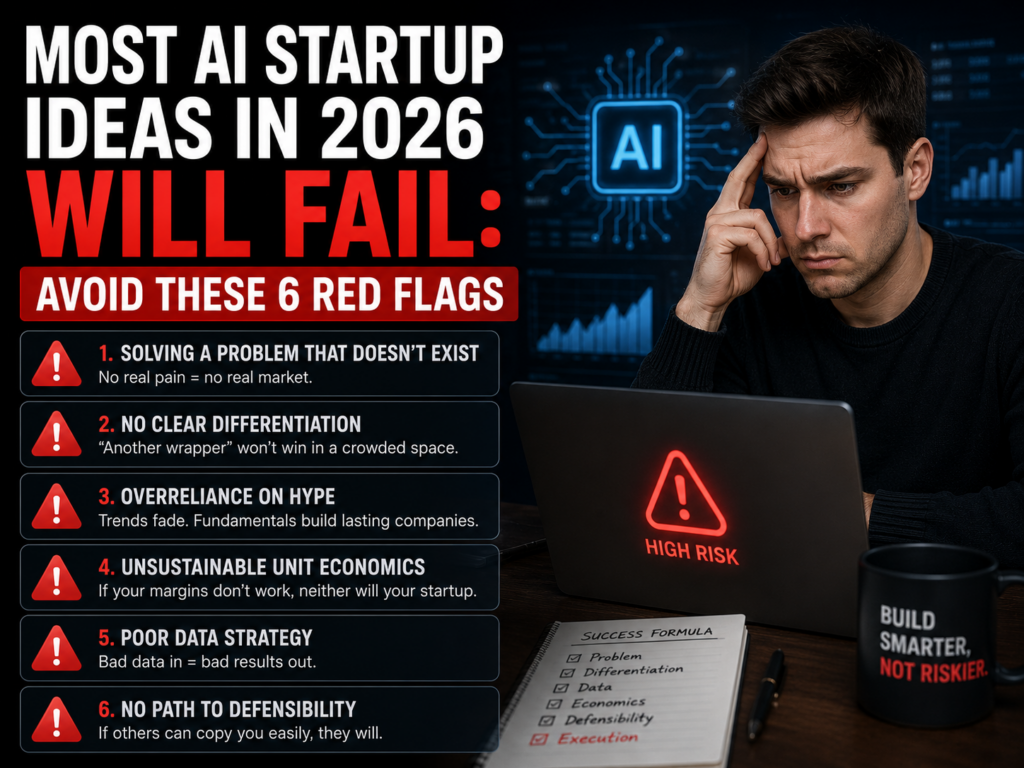
Not every startup idea is right for every entrepreneur. Before committing, validate three things: Does a painful, specific problem exist? Are there customers willing to pay right now? Can you build or access the expertise to solve it better than alternatives? Start narrow, prove revenue, then expand.
Key Takeaways for Entrepreneurs in 2026
- AI-powered tools from customer support to vertical agents offer the highest margins and fastest paths to profitability for tech startups in 2026.
- B2B SaaS targeting underserved verticals consistently outperforms generic software on retention and pricing power.
- Compliance-driven markets including cybersecurity, ESG, and legal tech create non-negotiable demand that makes customer acquisition more predictable.
- Validate before you build. Talk to 50 potential customers before writing a single line of code.
Frequently Asked Questions
What are the most profitable tech startup ideas in 2026?
The most profitable tech startup ideas in 2026 include AI-powered customer support platforms, cybersecurity for SMBs, vertical AI agents, no-code development agencies, and B2B SaaS for niche verticals. These categories offer high margins, recurring revenue, and strong demand.
How much money do you need to start a tech startup in 2026?
Many tech startups in 2026 can be launched with $5,000 to $50,000 using no-code tools, AI APIs, and cloud infrastructure. SaaS businesses and no-code agencies have particularly low startup costs. Hardware or fintech startups may require $100,000 to $500,000.
Is AI a good space for new startups in 2026?
Yes. AI is the defining opportunity for entrepreneurs in 2026. The most profitable AI startup niches are vertical AI agents, customer support automation, AI content tools, and health AI. Build a focused vertical application rather than a general AI tool competing with OpenAI or Google.