Agentic OS is a new software model where AI agents act autonomously on user intent, while traditional SaaS relies on manual inputs, dashboards, and workflows.
Table of Contents
This distinction matters now because multiple AI startups around the world are already building the foundations of this next operating system and the shift will reshape how software actually works.
What Is an Agentic OS? Definition & How It Works
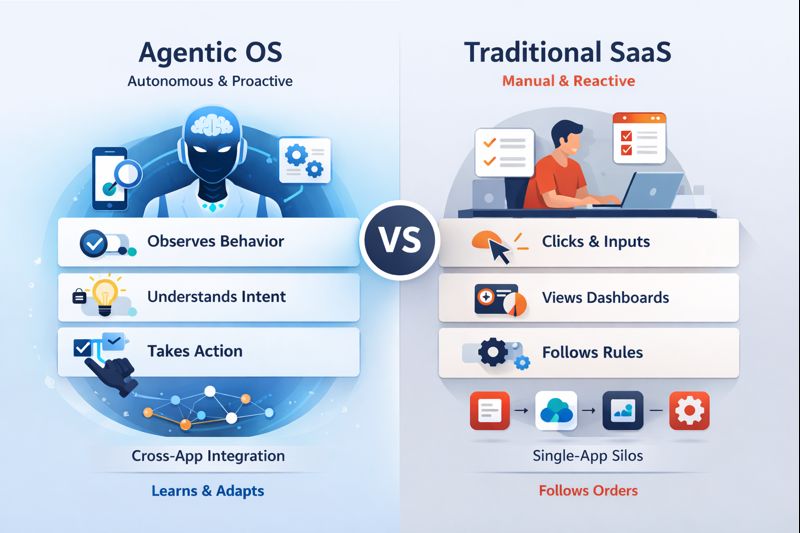
An Agentic Operating System represents a fundamental rethinking of how software interacts with users. Rather than waiting passively for commands, an Agentic OS observes behavior, interprets intent, and takes action across devices, apps, and environments without requiring repeated manual input.
Unlike traditional software, which executes predefined tasks in response to user clicks, an Agentic OS uses autonomous AI agents that reason about context, make decisions proactively, and adapt behavior based on outcomes. The system learns continuously, refining decisions over time without human intervention.
In simple terms: Traditional software is a tool you use. An Agentic OS is an intelligence that works on your behalf. This is the core difference between reactive software and the next-generation SaaS that AI startups are building.
This definition alone positions Agentic OS as more than just an incremental improvement on SaaS dashboards. It’s a categorical shift in how intelligent software platforms fundamentally operate.
Related Reading: Anthropic’s guide to building with Claude covers agent frameworks and autonomous workflows that underpin agentic systems.
How an Agentic OS Works: The Core Layers of Autonomous AI Software
An Agentic OS operates as a continuous intelligence layer rather than a static application. The architecture typically involves four key phases that define how autonomous AI software functions:
Observation Layer. The system continuously observes user behavior across devices, apps, and environments. This includes activity data, preferences, schedules, historical patterns, and contextual signals. The Agentic OS builds a rich understanding of intent by monitoring not just explicit commands, but implicit actions and preferences. This is foundational to how AI agents platform operate differently from traditional SaaS.
Interpretation Phase. AI agents interpret intent, not just commands. Using reasoning models and long-term memory, the system understands what users actually need—not just what they asked for. This layer distinguishes Agentic OS from traditional natural language interfaces that simply parse keywords. It’s what makes this next-generation SaaS truly intelligent.
Action Execution. The system plans and executes tasks autonomously. This might include recommending next steps, executing workflows across multiple tools, automating repetitive processes, or adjusting decisions in real time based on changing conditions. Crucially, the Agentic OS acts without waiting for approval on every step—a radical departure from traditional SaaS workflows.
Learning & Adaptation. The system learns from outcomes, refining future decisions without requiring repeated manual input or retraining. This creates a feedback loop where the Agentic OS becomes more aligned with user preferences over time. This continuous learning is what separates future of SaaS from legacy systems.
Deep Dive: OpenAI’s function calling documentation demonstrates how models execute actions autonomously, a core layer of agentic operating systems.
Each phase feeds into the next, creating a self-improving cycle that traditional SaaS simply cannot match.
Agentic OS vs Traditional SaaS: Key Differences Explained
The comparison reveals why AI startups are moving away from the SaaS model entirely and building autonomous AI software instead.
| Aspect | Traditional SaaS | Agentic OS |
|---|---|---|
| Core Function | Task execution via predefined rules | Decision-making + autonomous action |
| User Interaction | Manual inputs, clicks, dashboard navigation | Intent-based, minimal input required |
| Intelligence Model | Rules-based or feature-level ML add-ons | Autonomous AI agents at system core |
| Learning | Static, vendor-driven updates | Continuous, real-time adaptation |
| Operational Scope | Single application or function | Cross-app, cross-device, cross-context |
| User Experience | Reactive (user initiates, system responds) | Proactive (system anticipates, acts) |
Core Function: Traditional SaaS is built for task execution—you input data, it processes according to predefined rules. Agentic OS is built for decision-making and action. It decides what needs to happen, then makes it happen.
User Interaction Model: SaaS requires manual inputs, clicks, and dashboard navigation. The burden of orchestration sits with the user. Agentic OS requires minimal input and operates based on intent. Users describe outcomes; the system figures out how to achieve them.
Intelligence Architecture: SaaS typically uses rules-based automation or machine learning as a feature-level add-on. Agentic OS places autonomous AI agents at the center of the operating system itself. This is a structural difference, not a feature difference.
Learning & Evolution: SaaS is static or updates only when the vendor releases new versions. Agentic OS learns continuously from user behavior and adapts in real time. This continuous adaptation is characteristic of intelligent software platforms.
Operational Scope: SaaS excels within a single application or function. Agentic OS operates across apps, devices, and contexts—it’s designed for environments where software needs to be interconnected. The future of SaaS 2026 requires this cross-platform capability.
User Experience: SaaS is fundamentally reactive. You initiate action, then wait for results. Agentic OS is proactive. It anticipates needs, suggests actions, and executes without constant prompting.
This isn’t a minor feature difference. This is a restructuring of how software should work—and it’s why next-generation SaaS companies are betting on agentic architecture.
Learn More: Anthropic’s research on Constitutional AI explores how autonomous agents maintain alignment and safety—critical for agentic operating systems.
Which AI Startups Are Building Agentic OS Right Now?
Yes, multiple companies are actively building toward agentic operating systems. While no company has yet launched a fully unified Agentic OS, several AI-first startups and frontier labs around the world are developing its core layers in 2026.
OpenAI (United States) — Reasoning & Agent Framework
OpenAI’s agent frameworks and tool-calling capabilities are moving far beyond chat into autonomous task execution. The company’s reasoning models are designed to plan, make decisions, and act across software environments. GPT-4’s function-calling and recent developments in chain-of-thought reasoning signal a clear move toward agentic workflows where the AI manages task orchestration rather than just answering questions. This positions OpenAI as a key foundation for the future of SaaS.
Resource: OpenAI Platform Documentation – Production guides for building agentic systems with GPT models.
Anthropic (United States) — Extended Context & Memory
Claude’s agentic workflows, extended context windows (up to 200,000 tokens), and long-term memory capabilities enable multi-step reasoning and autonomous decision-making—core requirements of any Agentic OS. Anthropic has been explicit about building systems that operate as agents rather than just chatbots, positioning Claude as a foundation layer for agentic software and intelligent software platforms.
Resource: Claude API Documentation – Comprehensive guide to Claude’s agentic capabilities and vision features for autonomous software.
Adept AI (United States) — Screen Understanding & Autonomy
Adept’s ACT-1 was perhaps the clearest early signal of Agentic OS thinking. The system was designed to observe screens, understand user intent, and take actions across applications autonomously. While the company has evolved, the core insight remains valid: software should act on behalf of users, not just assist them. This is a defining characteristic of next-generation SaaS.
Resource: Adept AI Research – Technical papers on multimodal agents and autonomous action execution.
Cognition Labs (United States) — Autonomous Software Engineering
Cognition’s Devin operates as an autonomous AI software engineer—planning tasks, executing code, iterating on problems, and learning from failures. Devin doesn’t wait for instructions on every step; it operates with agency. This is Agentic OS thinking applied to developer environments, proving the concept works in high-stakes, complex domains and proving autonomous AI software is production-ready.
Resource: Devin: Autonomous AI Engineer – Live demonstration of agentic OS principles in software development.
Rewind AI (United States) — Persistent Memory Layer
Rewind’s personal data layer and memory engine point toward a foundational capability of any Agentic OS: persistent, personalized context. Without understanding user history and preferences deeply, an Agentic OS cannot make good autonomous decisions. Rewind’s infrastructure suggests one path toward that layer, essential for AI agents platform success.
Resource: Rewind: Personal Data Infrastructure – Overview of persistent memory systems for AI agents.
Apple (Signals Only) — On-Device Agentic Hints
Apple’s increasing emphasis on on-device intelligence, health data integration, and proactive suggestions hints at an agentic direction, even if not explicitly branded that way. The company’s focus on privacy-preserving, always-on intelligence suggests internal thinking about OS-level agents and the future of SaaS 2026.
Resource: Apple Intelligence Overview – Official documentation on Apple’s on-device AI capabilities.
None of these companies have shipped what most would call a “full Agentic OS.” But together, they’re building the building blocks: autonomous reasoning, long-term memory, tool integration, screen understanding, learning loops, and persistent context. These are the foundations of next-generation SaaS.
The Agentic OS Stack: What AI-First Startups Are Building
The infrastructure emerging in 2026 reveals what a real Agentic OS requires. This is the stack that defines autonomous AI software and next-generation SaaS:
Reasoning Layer. Foundation models with extended reasoning and planning capabilities. Companies like OpenAI, Anthropic, and others are racing to build models that reason about complex problems rather than just pattern-match. This is the cognitive foundation of any agentic operating system.
Memory Layer. Long-term, personalized context that persists across sessions. Without this, agents cannot learn or build understanding. Rewind, various vector database companies, and embedding startups are building this essential layer for intelligent software platforms.
Action Layer. Tools and APIs that allow agents to execute across software ecosystems. This includes screen understanding (computer vision), API integrations, and workflow orchestration—the operational foundation of autonomous AI software.
Learning Layer. Systems that adapt based on outcomes, user feedback, and environmental changes. Reinforcement learning from human feedback (RLHF) and continual learning approaches are essential here for AI agents platform that improve over time.
Integration Layer. Cross-platform coordination. An Agentic OS must work across devices, apps, and services—unlike SaaS, which lives in a single dashboard. This is what separates next-generation SaaS from legacy systems.
Recommended Reading: LangChain Framework Documentation – Popular open-source framework for building agentic applications and autonomous AI software.
Most AI-first startups today are building one or two of these layers. The first startup to integrate all five coherently will define the category and own the future of SaaS 2026.
Why AI Startups Are Moving Faster Than Big Tech Companies
Big technology companies have massive installed bases of SaaS products. Reimagining software as Agentic rather than dashboard-driven requires cannibalizing existing revenue. This creates organizational inertia that prevents traditional SaaS companies from innovating toward autonomous AI software.
AI startups have no legacy to defend. They’re building from first principles, asking: “What if software could reason and act?” rather than “How do we add AI features to our dashboard?” This fundamental difference is why AI-first startups are winning in the race to build intelligent software platforms.
OpenAI and Anthropic occupy a middle ground—they’re research-first organizations building the foundation models necessary for Agentic OS, but they’re not yet building the full stack themselves. That’s left to specialized AI-first startups focused on next-generation SaaS architecture.
The competitive dynamic is clear: foundation model companies build the brains, integration startups build the middleware, and specialized Agentic OS companies build the end-user experiences. This is the future of SaaS 2026.
Further Exploration: Y Combinator’s AI Startup Guide – Insights from founders building next-generation AI products and autonomous systems.
What’s Still Missing for a Complete Agentic Operating System
Despite rapid progress, several critical pieces remain unsolved for autonomous AI software to reach mainstream adoption:
Trustworthiness at Scale. Users need to trust that autonomous agents won’t make catastrophic mistakes. This requires either superhuman reliability or robust oversight mechanisms. Current systems are not reliable enough for autonomous financial decisions, medical recommendations, or critical infrastructure tasks—limiting where agentic operating systems can deploy.
Cross-Platform Coordination. Today, most agentic systems work within a single ecosystem. A true Agentic OS needs permission and integration across hundreds of third-party applications and services. This is a coordination problem, not just a technical one, preventing next-generation SaaS from reaching full potential.
Explainability & Transparency. When an Agentic OS makes a decision or takes action, users need to understand why. Black-box reasoning, even if accurate, won’t be acceptable for critical decisions. Interpretability remains an open research problem for autonomous AI software.
Data Privacy at Scale. A system that observes all behavior across all apps requires access to sensitive personal data. Solving this without compromising privacy is perhaps the hardest problem ahead for intelligent software platforms.
Industry Standardization. Without agreed-upon standards for how agents communicate, coordinate, and share context, we’ll end up with fragmented, incompatible systems. This requires industry alignment that doesn’t yet exist and will define the future of SaaS 2026.
Read More: MIT’s AI Policy Research – Academic research on AI alignment and autonomous system safety.
The companies solving these problems will become the infrastructure layer that all other Agentic OS startups build on top of.
Agentic OS Timeline: When Will This Replace Traditional SaaS?
The shift won’t happen overnight. Traditional SaaS isn’t going away; it’s being absorbed into the next-generation SaaS paradigm.
In 2026, Agentic OS represents the direction of travel, not the current state of production software. Most businesses still rely heavily on SaaS dashboards and manual workflows. But the trajectory is clear: software is moving from reactive to proactive, from static to adaptive, from isolated applications to coordinated autonomous AI software agents.
2026-2028: Foundation model companies and specialized AI-first startups perfect reasoning, memory, and action layers. First vertical implementations (e.g., Agentic OS for development, operations, customer support) reach production. Next-generation SaaS categories begin to emerge.
2028-2030: Integration with mainstream applications accelerates. Major cloud providers begin offering Agentic OS SDKs. Enterprise adoption starts in process-heavy industries. The future of SaaS 2026 begins to materialize.
2030+: SaaS companies that haven’t added agentic capabilities begin losing market share. The distinction between “SaaS” and “Agentic OS” becomes quaint, like the distinction between “software” and “cloud software” is today. Intelligent software platforms become the standard expectation.
Why Agentic OS Matters for Founders & Investors in 2026
The difference between traditional SaaS and Agentic OS isn’t academic. It’s about productivity, user experience, and competitive advantage.
Traditional SaaS software creates a bottleneck: the human user. No matter how well-designed a dashboard is, it still requires human attention, decision-making, and input. An Agentic OS removes this bottleneck by delegating decisions to systems that can reason, learn, and act continuously.
For Founders Building in 2026: The question isn’t “Should we build a SaaS company?” It’s “What layer of the Agentic OS stack should we own?” The companies that answer this question thoughtfully will define the next generation of valuable software and own significant market share in the future of SaaS 2026.
For Investors: The signal is clear: AI-first startups that are building autonomous systems—not just AI-enhanced tools—are the ones positioned for the largest outcomes. The companies building toward agentic operating systems will likely achieve higher valuations than incremental SaaS improvements.
Industry Insights: Sequoia Capital’s AI Report – Investment thesis on next-generation AI software and agentic systems.
Conclusion: The Operating System Era for Autonomous Intelligence
Agentic OS represents more than an incremental improvement on SaaS dashboards. It’s a categorical shift in how software operates: from static tools controlled by users to dynamic systems that reason, decide, and act on behalf of users.
Multiple AI-first startups around the world are already building toward this future, even if the fully integrated intelligent software platform doesn’t yet exist. The companies that master reasoning, memory, action, learning, and cross-platform coordination will define what software means in 2027, 2028, and beyond.
The SaaS era will eventually be remembered as the era of passive software—tools that waited for instructions. The Agentic OS era is already beginning, and it belongs to the AI startups moving fastest toward building the next-generation SaaS and autonomous AI software that actually works on your behalf.
Frequently Asked Questions (FAQ)
What exactly is an Agentic OS?
An Agentic Operating System is software that uses autonomous AI agents to observe user behavior, interpret intent, make decisions, and take action without requiring constant manual input. Unlike traditional SaaS dashboards that react to user commands, an Agentic OS proactively operates on the user’s behalf, learning and adapting continuously.
How is Agentic OS different from traditional SaaS?
The core difference is autonomy and intelligence. Traditional SaaS requires users to input data, navigate dashboards, and initiate actions. Agentic OS observes behavior, understands intent, executes tasks autonomously, and learns from outcomes. SaaS is reactive; Agentic OS is proactive. For a detailed breakdown, see our comparison table above.
Is Agentic OS available now?
No single company has launched a fully unified Agentic OS yet. However, multiple AI startups (OpenAI, Anthropic, Cognition Labs, Adept AI, Rewind AI) are building core layers of agentic systems in 2026. Early implementations exist in specialized domains like software engineering (Devin) and development workflows, but mainstream adoption is still 2-3 years away.
Which companies are building Agentic OS?
Foundation Model Providers: OpenAI, Anthropic Agent Infrastructure: Adept AI, Cognition Labs, Rewind AI Signals/On-Device: Apple
What does the Agentic OS stack include?
The complete Agentic OS stack requires five layers:
- Reasoning Layer – Foundation models with planning capabilities
- Memory Layer – Persistent, personalized context
- Action Layer – Tools, APIs, and execution frameworks
- Learning Layer – Continuous adaptation systems
- Integration Layer – Cross-platform coordination
Most startups today are building 1-2 layers; the first to integrate all five will define the category.
Why are AI startups moving faster than big tech?
Big tech companies (Microsoft, Google, Amazon) have massive SaaS revenue to protect, creating organizational inertia. Building Agentic OS would cannibalize existing products. AI startups have no legacy business to defend and can build from first principles. This is why innovation in agentic systems is coming from specialized AI-first companies.
When will Agentic OS replace SaaS?
It won’t happen overnight. We expect:
- 2026-2028: Vertical implementations reach production
- 2028-2030: Enterprise adoption accelerates
- 2030+: The SaaS/Agentic OS distinction becomes irrelevant
SaaS will be absorbed into agentic architecture, not replaced by it.
What are the main challenges for Agentic OS?
Five critical unsolved problems:
- Trustworthiness – Ensuring autonomous agents don’t make catastrophic mistakes
- Cross-Platform Coordination – Integration across hundreds of third-party apps
- Explainability – Making agent decisions understandable to users
- Data Privacy – Managing extensive behavioral data safely
- Standardization – Industry agreement on agent communication protocols
Should I build an Agentic OS startup in 2026?
The better question is: Which layer of the Agentic OS stack should you own? Building the complete system is premature. Focus on:
- A specific reasoning layer innovation
- A critical infrastructure problem (memory, integration)
- A vertical implementation (e.g., developer tools, operations)
Startups solving one layer deeply will have better odds than those trying to build the entire stack.
What should investors look for in Agentic OS startups?
Look for teams that are:
- Building a critical layer of the agentic stack (not a feature)
- Solving a coordination or infrastructure problem
- Demonstrating early traction in specialized domains
- Clear about long-term vision beyond AI-enhanced SaaS
Avoid teams that are simply adding AI chatbots to existing products—that’s not Agentic OS.
How does Agentic OS impact productivity?
Dramatically. Traditional SaaS creates a human bottleneck—dashboards, manual workflows, user input. Agentic OS removes this bottleneck by delegating decisions to systems that reason and act continuously. Expected productivity gains: 2-5x in process-heavy industries.
What’s the difference between an AI agent and an Agentic OS?
An AI agent is a single autonomous system that performs specific tasks. An Agentic OS is a coordinated operating system where multiple agents work together across apps, devices, and contexts. Agents are components; Agentic OS is the infrastructure that orchestrates them.
Can existing SaaS companies transition to Agentic OS?
Yes, but it’s difficult. They need to:
- Rebuild core architecture around autonomous agents
- Develop persistent memory systems
- Integrate with external platforms
- Accept that users will interact with dashboards less
Many will add agentic features incrementally rather than rebuild entirely. Specialized startups will move faster.
What role do foundation models play in Agentic OS?
Foundation models are essential but not sufficient. They provide the reasoning capability, but Agentic OS requires memory, action execution, learning, and integration layers built on top. OpenAI and Anthropic provide the cognitive foundation; startups build the complete system.
Will Agentic OS work offline?
Partially. On-device reasoning and action execution are possible (Apple’s approach), but persistent memory and cross-platform coordination require connectivity. Hybrid models (on-device + cloud) are most realistic.
How will Agentic OS affect employment?
High-impact: Jobs involving repetitive decision-making, data processing, and workflow orchestration will be most disrupted. High-value work requiring human judgment will see productivity amplification. Net effect: workforce transformation, not elimination, with significant retraining needs.
Which vertical will see Agentic OS first?
Most likely: Software development (proven by Devin), operations management, customer support, and financial analysis. These domains have clear workflows, measurable outcomes, and high ROI on automation. Consumer applications will follow 1-2 years later.
What’s the business model for Agentic OS startups?
Options include:
- Infrastructure licensing – Sell the agentic platform to other companies
- Vertical SaaS – Own end-user experience in a specific industry
- Middleware – Provide integration and coordination layer
- Hybrid – Combination of platform + vertical implementation
Most successful will combine infrastructure with one strong vertical implementation.
Want to stay ahead of where startups and software are heading next?
Startup Pill breaks down emerging ideas, new categories, and early signals shaping the future of AI, SaaS, and global startups.