There is a job opening at a Fortune 500 company. The role involves handling hundreds of customer conversations daily, working across time zones without a break, speaking fluently in over a dozen languages, and never calling in sick.
The salary?
Zero.
The candidate?
Not human.
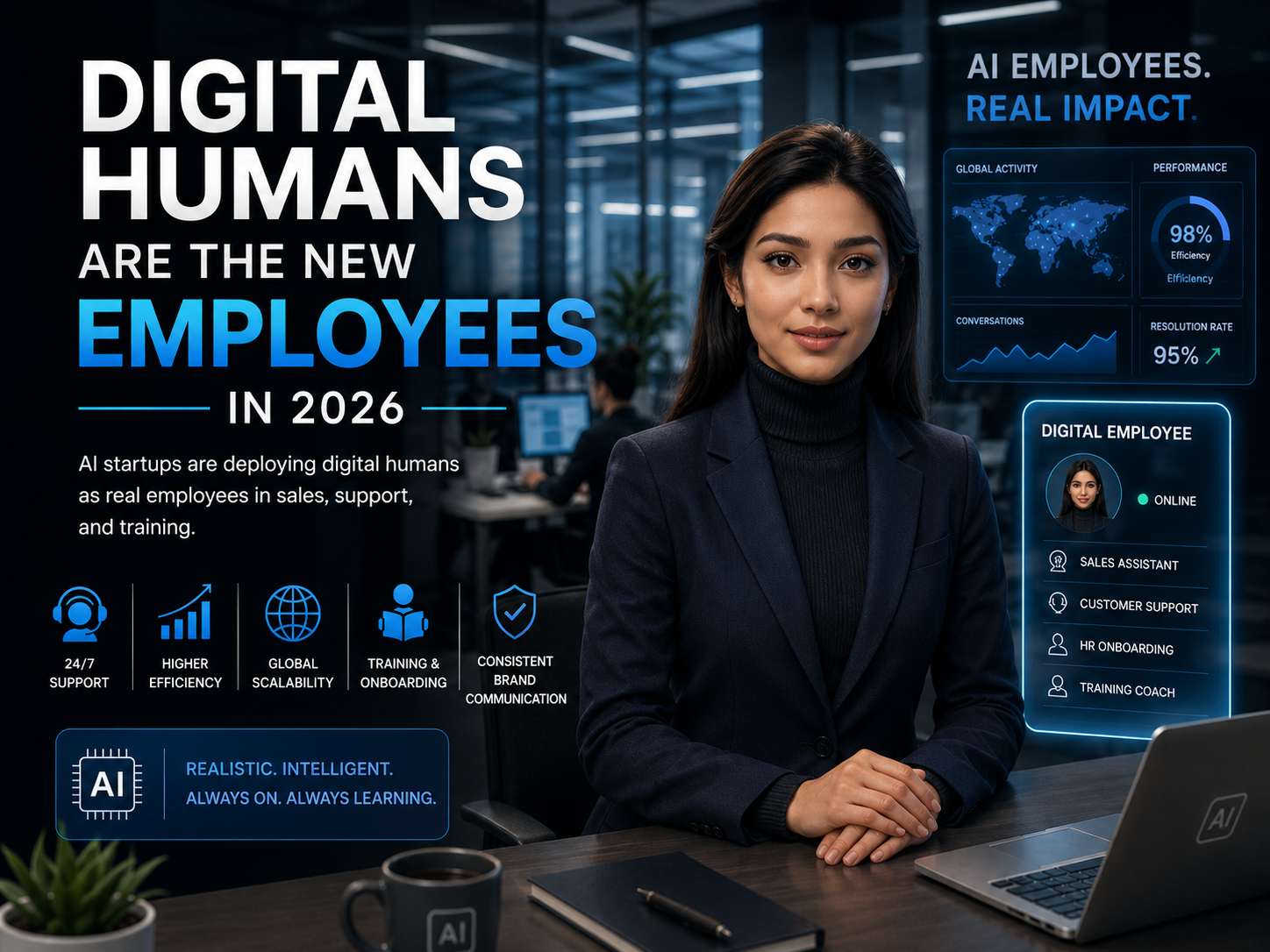
This is not a thought experiment. It is happening right now, inside companies across banking, healthcare, retail, and tech. Digital humans, AI-powered avatars built to look, speak, and respond like real people, are quietly moving from experimental pilots into core business infrastructure. And the startups behind this shift are growing faster than most people realize.
The Technology Finally Caught Up With the Ambition
For years, the idea of a virtual employee felt like science fiction. Early chatbots were clunky. Virtual assistants were robotic. The gap between what companies wanted and what the technology could deliver was too wide to ignore.
That gap has closed.
Modern digital humans are built on a convergence of large language models, real-time voice synthesis, facial animation engines, and emotionally adaptive response systems. They do not just answer questions. They read conversational cues, shift tone based on context, and maintain the kind of consistency that human teams, even well-trained ones, struggle to sustain across thousands of daily interactions.
The behavioral realism is what changes everything. When a customer cannot tell whether they are speaking with a human or a machine, the operational implications for businesses become enormous.
Meet the Startups Rewiring the Workforce
A handful of companies are leading this transformation, each approaching the synthetic workforce from a different angle.
Synthesia, headquartered in London, has built one of the most widely deployed platforms for AI video presenters. Its technology allows companies to create on-screen presenters for training videos, internal communications, and customer onboarding content across more than 120 languages, with no cameras, no studios, and no production delays. Enterprises that previously spent weeks and significant budget on multilingual video content can now produce it in hours. Synthesia is not replacing creative teams. It is making certain creative workflows irrelevant.
Soul Machines is solving a different problem. Customer-facing roles in industries like healthcare and financial services require more than accuracy. They require warmth. Soul Machines builds emotionally responsive digital humans designed to make people feel heard, not processed. Their avatars are already deployed by some of the largest banks and insurance providers in the world, handling sensitive conversations that most companies previously believed required a human touch.
Hour One focuses on the sales and training pipeline. Its AI video agents deliver product pitches, compliance training, and brand messaging with zero variance across global markets. There is no version of an Hour One presenter that had a bad morning, forgot the key talking points, or rushed through the closing slide.
D-ID has built its platform around real-time conversational video, powering marketing campaigns and customer engagement tools where the interaction itself is the product. Meanwhile, UneeQ has carved out a niche in enterprise environments, particularly in telecom and banking, where digital humans serve as the consistent, always-available front door to a company’s service ecosystem.
The Roles Being Handed Over
The adoption is not random. Digital humans are taking hold fastest in roles that share a common characteristic: high volume, high repetition, and a need for consistent quality across every single interaction.
Customer support is the most obvious starting point. The average enterprise support team handles tens of thousands of queries monthly. Response time varies. Quality varies. Staffing costs are significant. An AI agent eliminates the variance entirely, handles unlimited simultaneous conversations, and costs a fraction of the headcount equivalent.
Sales is the next frontier. Digital humans are being deployed as lead qualification agents, demo hosts, and product explainers. They work every lead in the pipeline with the same energy and precision, regardless of whether it is the first call of the day or the four hundredth.
HR and internal operations teams are using digital avatars to handle onboarding workflows, policy communication, and employee FAQ responses at scale. Training departments are replacing instructor-led video content with adaptive AI tutors that respond to learner behavior in real time.
The pattern is clear. If a role is defined by what gets said rather than by what gets decided, a digital human can now do it better, faster, and cheaper.
Why 2026 Is the Inflection Point
Several forces converged to make this the breakout year for digital human adoption.
The cost of deployment dropped significantly. Platforms that previously required enterprise-level budgets and custom integration work are now accessible to mid-market companies. The quality of AI voice and facial animation crossed a threshold where audiences stopped instinctively clocking the artificiality. And the post-pandemic normalization of video-first communication removed the cultural resistance that might otherwise have slowed adoption.
Businesses that piloted digital humans during the 2023 and 2024 experimentation phase are now scaling what worked. The pilots became products. The products became infrastructure.
The Risks the Industry Is Not Talking About Enough
The business case is compelling. The risks are real and underexamined.
Job displacement in service roles is accelerating. Positions in customer support, inside sales, and training delivery that were considered stable, entry-level career paths are being structurally eliminated, not automated into something new but removed from the workforce equation entirely.
Transparency is becoming a regulatory flashpoint. In multiple markets, regulators are now examining whether companies have an obligation to disclose when a customer is speaking with an AI rather than a human. The disclosure gap is not just an ethical concern. It is becoming a legal one.
Data privacy risks compound quickly at scale. Digital humans capture voice data, behavioral patterns, and interaction histories across millions of engagements. How that data is stored, used, and protected is a question most enterprise deployments have not fully answered.
The Bigger Shift: An AI Identity Economy Is Forming
Beneath the workforce story, something larger is taking shape.
Companies are beginning to think about digital employees the way they think about software licenses: scalable assets that can be deployed, configured, and expanded as business needs change. Individuals are exploring the commercial potential of their own AI avatars, personal digital identities that can represent them in professional contexts without requiring their physical presence.
The concept of an AI identity economy, where intelligence and digital presence become infrastructure rather than tools, is no longer a futurist talking point. It is an architecture decision that enterprise technology teams are beginning to make right now.
The startups building digital humans in 2026 are not just automating conversations. They are defining what it means to work, to represent, and to show up in the decade ahead.
FAQ
What are digital humans in AI? Digital humans are AI-generated avatars that simulate real human interaction using natural language processing, facial animation, and emotionally adaptive response systems. They are deployed in customer support, sales, HR, and training roles.
Which AI startups are leading the digital human space? The leading startups include Synthesia, Soul Machines, Hour One, D-ID, and UneeQ, each specializing in different enterprise verticals from training content to emotionally intelligent customer service.
Are digital humans replacing jobs? Yes. Roles defined by high-volume, repetitive communication in customer support, inside sales, and training are being displaced. The pace is accelerating as deployment costs fall and output quality rises.
What is the AI identity economy? It is an emerging model where digital identities, both corporate and personal, become scalable, deployable assets. Companies operate fleets of digital employees. Individuals license AI versions of themselves. Identity becomes infrastructure.
🤖 The workforce is changing. Are you keeping up?
Digital humans are already replacing traditional roles in sales, support, and training — and the companies building this technology are scaling fast.
Stay ahead of the AI workforce revolution. Explore more startup insights, funding news, and emerging tech trends on StartupPill.