If you are a founder asking what are the best energy startup ideas in April 2026 that could become billion dollar companies, this blueprint explains five high growth opportunities in AI power, microgrids, hydrogen, storage, and grid software. It is written for builders in the United States, Europe, India, and the Middle East who are watching AI, climate policy, and grid constraints collide in real time.
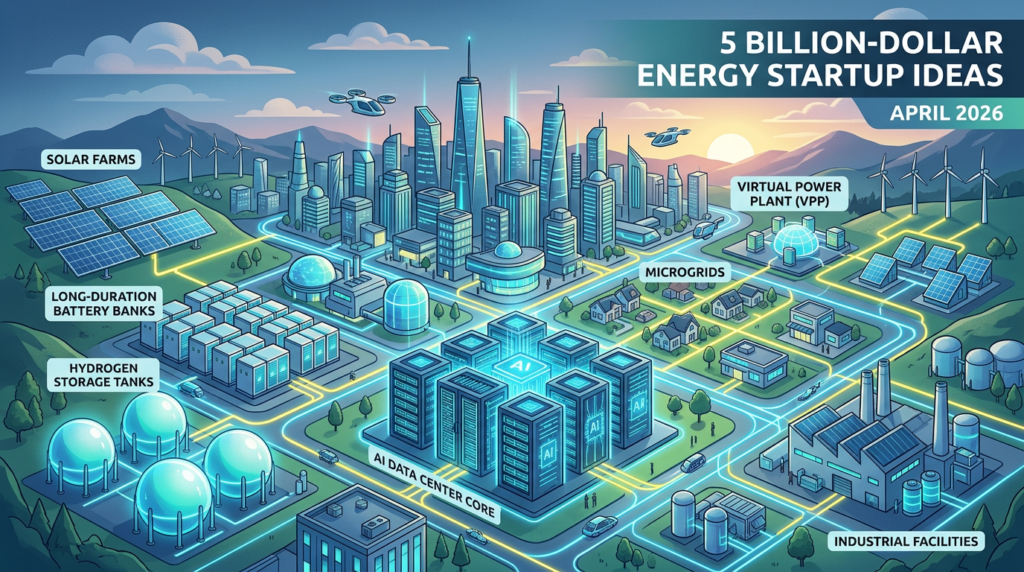
Why Energy Is the New Bottleneck in 2026
In April 2026, energy is no longer just a background input. It is the hard constraint on AI, cloud, electric vehicles, and industrial growth. Hyperscale AI data centers are drawing power at the scale of small cities, forcing utilities and regulators in several regions to slow or pause new connections. At the same time, countries are doubling down on net zero commitments, with new incentives for clean power, long duration storage, hydrogen, and smarter grids.
Three forces are shaping the opportunity.
First, the AI compute explosion. AI clusters now require vast, continuous power, and power, not GPUs, is increasingly the limiting factor.
Second, decarbonization mandates. Governments in the United States, the European Union, and India are spending heavily to accelerate renewables, storage, and hydrogen deployment.
Third, grid congestion and aging infrastructure. Interconnection queues stretch for years, and distribution networks were not designed for millions of EVs, solar rooftops, and AI loads.
This combination is painful for utilities but very attractive for startups. It opens gaps around off grid AI power, microgrids, long duration storage, hydrogen retrofits, and grid operating systems, any of which can produce the next decacorn.
Idea 1: Autonomous Energy as a Service Microgrids for Enterprises
The opportunity
Large enterprises now worry about two things above all: power cost and power reliability. AI campuses, semiconductor fabrication plants, industrial parks, and IT hubs cannot afford outages or grid delays that last for years. An autonomous, AI managed microgrid solves this by turning a site into its own mini utility. It combines solar, batteries, possibly hydrogen based backup, and intelligent controls behind the meter.
Instead of asking how to reduce the bill, these customers are asking how to eliminate dependence on an unreliable grid. That shift supports premium pricing and long term contracts.
How the startup works
Your company designs, finances, and operates microgrids for factories, data centers, and commercial campuses under an Energy as a Service model. You install solar, long duration or lithium storage, backup generators or fuel cells, and a control system that forecasts and optimizes energy flows in real time. Customers pay a monthly or per kilowatt hour fee that is lower than their current blended grid cost, while you capture additional upside by cutting peak demand charges and monetizing flexibility.
Why this can reach $10B
The addressable spend is very large, because industrial and commercial power bills in the United States, Europe, and India total hundreds of billions of dollars annually. Once deployed, microgrids are sticky. Hardware, financing, and software together create long term lock in. You can scale by standardizing designs across verticals and regions, similar to a productized service.
Regions like Texas, California, Germany, and Indian states with weak distribution networks are strong candidates for early projects.
Idea 2: AI Powered Stranded Energy Data Centers
The opportunity
Stranded energy is power that is cheap but hard to move or sell. Examples include flare gas in oil fields, curtailed wind power in congested grids, and remote hydro or solar that lacks transmission capacity. At the same time, AI companies are hungry for power, sensitive to costs, and increasingly flexible about location as long as latency requirements are satisfied.
Crusoe Energy has already shown how large this can become by converting flare gas into power for modular data centers, reaching a valuation around ten billion dollars by 2025. That model can be extended and specialized for AI.
How the startup works
You deploy modular, GPU rich data centers directly at stranded energy sources. Your system converts gas or remote renewables into power on site, runs AI training or batch inference workloads, and connects to customers via high bandwidth networks. An AI scheduler packs workloads where energy is cheapest and most available, turning the network of sites into a virtual, distributed cloud.
Revenue comes from long term compute contracts with AI labs and cloud platforms, revenue sharing with energy owners such as oil companies and wind farm operators, and potentially carbon credits or emissions reductions for flare mitigation where frameworks allow.
Why this can reach $10B
Demand for AI compute is effectively unbounded, so power optimized clouds can grow as fast as you can add sites. The model leverages existing energy assets instead of waiting years for new plants and transmission lines. You can expand across United States shale basins, North Sea wind zones, and sunny regions in India and the Middle East.
The long term vision is to become a low cost, energy aware cloud for AI workloads that spans multiple continents.
Idea 3: Long Duration Energy Storage Platforms Beyond Lithium
The opportunity
Lithium ion batteries are excellent for storing energy for a few hours, but they are not economical for multi day storage. Yet grids increasingly need storage that can bridge multi day renewable lulls and replace coal and gas peaker plants. Long duration energy storage, often defined as ten to one hundred or more hours, is the missing layer for a fully renewable grid.
Form Energy, a leading iron air battery company, demonstrates this trajectory with multi day storage based on low cost materials like iron and air, and has projects announced in the United States and overseas.
How the startup works
You can play a role in long duration storage in several ways.
You can be a technology developer that invents or commercializes a new chemistry such as iron air, flow batteries, or thermal storage with a clear cost advantage at scale. You can act as a project developer and integrator that packages existing long duration technologies into turnkey projects with financing and grid integration. You can build a software intelligence layer that provides dispatch optimization for mixed storage fleets across markets.
Projects sell capacity to utilities, earn revenue from capacity payments, and arbitrage energy prices by charging during low or negative prices and discharging during scarcity events.
Why this can reach $10B
The total addressable market is the entire global power system after renewable penetration reaches a certain level. Policy in the United States, Europe, and other markets increasingly favors long duration storage through mandates and incentives. Proven early deployments, such as Form Energy’s first overseas projects, indicate that utilities are ready to adopt such technologies at scale.
A company that combines cost effective technology, strong financing partners, and policy aware project development can become a global category leader.
Idea 4: Hydrogen Infrastructure and Industrial Retrofitting Platform
The opportunity
Hydrogen is moving from hype to hardware. The European Union, the United States, India, and Gulf states are funding gigawatt scale green hydrogen projects, but last mile infrastructure, including pipes, burners, turbines, and industrial processes, is lagging. Most industrial assets were designed for natural gas or other fuels, not hydrogen blends or pure hydrogen service.
Retrofit first solutions can unlock hydrogen demand much faster than full asset replacements.
How the startup works
Your startup becomes the bridge between hydrogen supply projects and industrial demand. You design and supply retrofit kits to make boilers, burners, turbines, and local pipelines hydrogen ready or blend ready. You offer safety, leak detection, and combustion monitoring systems that ensure compliance with evolving codes. You also provide engineering and consulting to map a phased transition from fossil only fuels to hydrogen blends and eventually higher hydrogen shares.
You monetize through hardware margins, installation services, multi year maintenance contracts, and software fees for monitoring and optimization tools.
Why this can reach $10B
Industrial sectors such as steel, cement, chemicals, and refineries are large emission sources with strong decarbonization pressure. Techno economic research supports hydrogen storage and hybrid microgrids as feasible decarbonization strategies when properly designed. Being embedded in the safety and compliance layer creates high switching costs and regulatory defensibility.
As green hydrogen costs fall and hydrogen trade ramps up, the company that owns this adapter layer can scale across multiple continents.
Idea 5: The AI Operating System for the Global Grid
The opportunity
Modern grids are trying to manage millions of distributed energy resources, including rooftop solar, home batteries, electric vehicles, heat pumps, flexible industrial loads, and AI data centers. Traditional control and planning tools were not built for this complexity, and outages or curtailment are becoming more common and more expensive.
An AI driven grid operating system can orchestrate these assets as one virtual power plant, improving reliability and lowering costs.
How the startup works
You build a software platform that forecasts demand and renewable output at high time and location resolution using machine learning. The platform sends control signals to distributed assets such as EV chargers, inverters, batteries, heating and cooling systems, and industrial loads to shift consumption and injection in real time. It also interfaces with wholesale markets and flexibility platforms to trade capacity and ancillary services.
Revenue comes from software contracts with utilities, grid operators, energy retailers, and cities, plus revenue shares from flexibility services and avoided upgrade costs.
Why this can reach $10B
Research and pilot projects show that virtual power plants and multi market strategies can significantly improve grid economics. The AI data center boom adds a powerful new customer segment that needs grid aware load management. Once deeply integrated with utility systems and device manufacturers, a grid operating system platform becomes very difficult to replace.
The global market spans North America, Europe, fast growing grids in India, and renewables heavy markets worldwide.
How Founders Can Capture These Opportunities
Across these five ideas, a common pattern appears. The most successful energy startups in 2026 will start with business and government customers, not consumers, selling to enterprises, utilities, and public entities where contract sizes are large and problems are urgent. They will bundle technology with financing and long term services to remove friction and create recurring revenue. They will build early partnerships with utilities, energy companies, equipment manufacturers, and regulators to navigate complexity instead of trying to disrupt everything alone.
AI, hydrogen, storage, and grid modernization are not separate themes. They are converging into one global infrastructure rebuild. Founders who design startups at these intersections, such as microgrids with long duration storage, stranded energy with AI compute, hydrogen retrofits with industrial software, or grid operating systems with EVs and AI clusters, are best positioned to build the next ten billion dollar energy company.

FAQs: Billion-Dollar Energy Startup Ideas for April 2026
1. What makes an energy startup a potential billion dollar company in 2026?
An energy startup can reach billion dollar scale when it solves a large, systemic bottleneck such as AI data center power, grid reliability, industrial decarbonization, or long duration storage, and can scale across multiple regions with repeatable projects and strong policy tailwinds.
2. Which regions are best for launching these energy startup ideas?
The most attractive regions in 2026 include the United States, Europe, India, and the Middle East, where AI data center growth, renewable buildout, and hydrogen or storage policies are all accelerating at the same time.
3. How do AI data centers create new opportunities for energy founders?
AI data centers consume massive, constant power, often stressing local grids and facing long interconnection delays, which opens opportunities for microgrids, stranded energy compute, hydrogen powered campuses, and grid optimization software.
4. Why is long duration energy storage so important now?
As solar and wind penetration grows, multi day periods of low generation become more common, and long duration storage technologies such as iron air batteries or hydrogen based systems are needed to replace fossil peaker plants and keep grids stable.
5. What is the role of hydrogen in next generation energy startups?
Hydrogen is emerging as a key vector for both energy storage and industrial decarbonization, creating opportunities for startups in hydrogen production, storage, transport, and especially retrofitting existing industrial equipment and pipelines to handle hydrogen blends.
6. How can AI and virtual power plants help stabilize the grid?
AI driven virtual power plant platforms connect and control many small assets such as solar, batteries, and EVs, forecasting demand and renewable output and shifting energy flows in real time to improve stability and reduce reliance on expensive peak power plants.
7. Where can founders learn more about global energy and climate roadmaps?
Founders can study free reports from the International Energy Agency, which summarize global net zero pathways, technology priorities, and policy trends that directly influence which energy startup models can scale.
Visit StartupIll.com for more deep dives into startups changing the world.