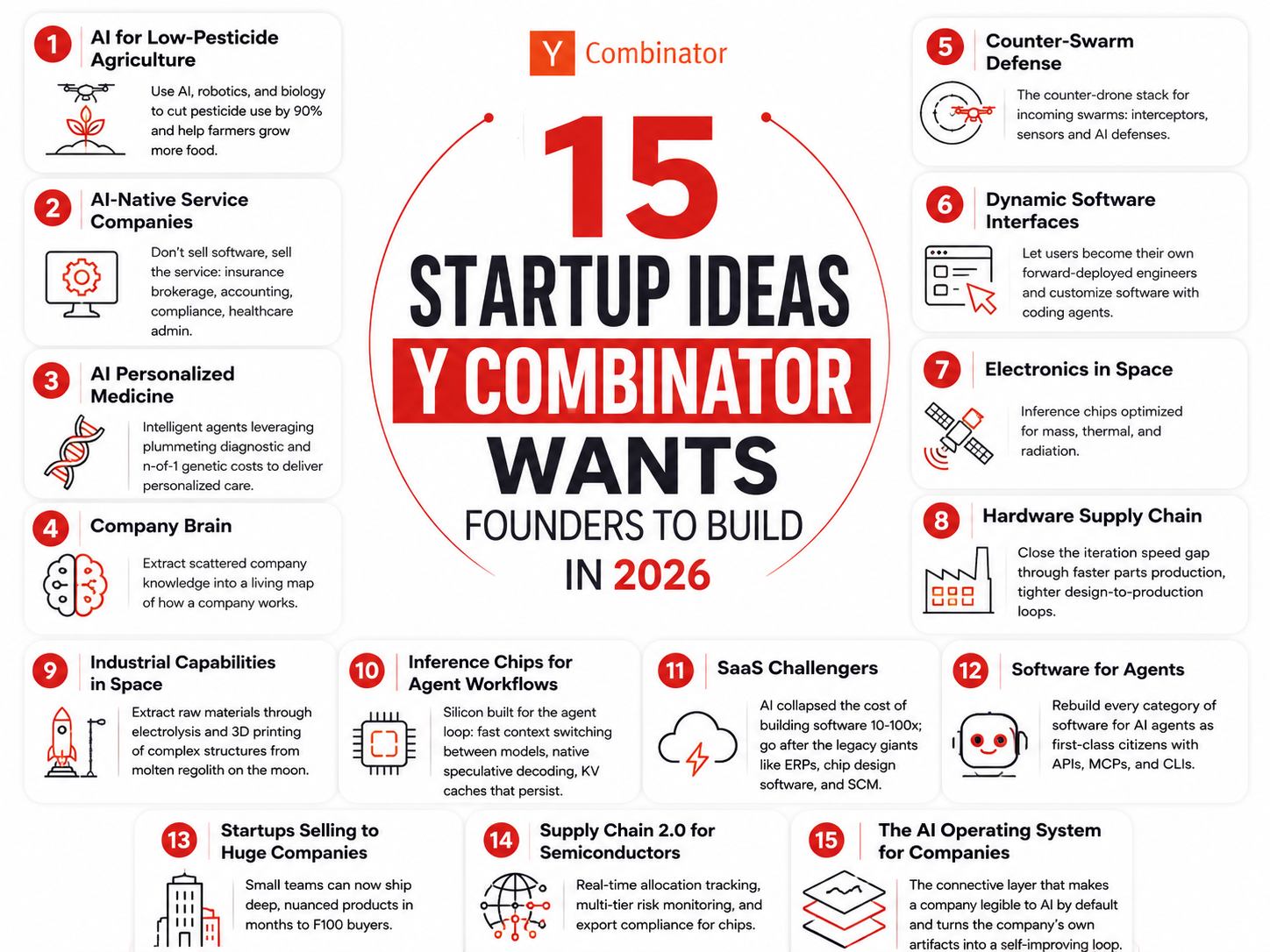
The startup ecosystem is changing faster than ever, and Y Combinator is once again signaling where the next generation of billion-dollar startups could emerge.
For Summer 2026, Y Combinator released a fresh “Requests for Startups” list that reveals one major shift: the future is no longer just software. Instead, the accelerator is aggressively looking for founders building AI infrastructure, semiconductor technologies, robotics, enterprise automation, and deep-tech systems that solve real-world industrial problems.
This year’s startup ideas reflect the rise of AI agents, autonomous workflows, chip shortages, and the growing global demand for advanced technology infrastructure.
Here are the 15 startup ideas Y Combinator wants founders to build in 2026 — and why these industries matter so much right now.
1. AI for Low-Pesticide Agriculture
Y Combinator wants startups that combine AI, robotics, and biology to reduce pesticide usage while improving crop output.
Agriculture is becoming one of the biggest opportunities for AI automation because food demand continues rising globally. AI-powered drones, crop analysis systems, and autonomous farming robots could transform how food is produced.
2. AI-Native Service Companies
YC believes the future of business services is changing completely.
Instead of selling software tools, startups can now sell entire AI-powered services such as:
- accounting
- compliance
- healthcare administration
- insurance operations
AI agents are making it possible for small teams to operate like large enterprises.
3. AI Personalized Medicine
Healthcare is becoming one of AI’s most important applications.
YC is looking for startups building intelligent medical agents that use genetic analysis, diagnostics, and patient data to create personalized healthcare systems.
As diagnostic costs continue falling, AI-driven healthcare startups could reshape the medical industry globally.
4. Company Brain
Modern companies generate enormous amounts of internal knowledge, but most of it remains scattered across emails, Slack messages, documents, and meetings.
YC wants startups that create a “living map” of company knowledge using AI systems capable of organizing and understanding enterprise workflows automatically.
5. Counter-Swarm Defense
Defense technology has become one of Silicon Valley’s fastest-growing sectors.
Y Combinator is interested in startups building systems that can defend against autonomous drone swarms using advanced sensors, interception systems, and AI-powered monitoring tools.
The rapid rise of drone warfare has created massive demand for next-generation defense infrastructure.
6. Dynamic Software Interfaces
Traditional software interfaces are becoming outdated.
YC predicts future software will adapt dynamically using AI agents that personalize workflows and interfaces in real time. Instead of fixed dashboards, users will interact with flexible AI-driven systems tailored to their specific tasks.
7. Electronics in Space
Space technology is entering a new industrial phase.
YC wants startups developing semiconductor systems optimized for space environments, including radiation-resistant chips and lightweight computing infrastructure for satellites and orbital systems.
The rise of private space companies is creating strong demand for advanced space electronics.
8. Hardware Supply Chain Startups
Global chip shortages exposed major weaknesses in hardware manufacturing systems.
YC is now encouraging startups that improve hardware production, logistics, component sourcing, and semiconductor manufacturing efficiency.
AI-driven supply chain optimization could become a trillion-dollar opportunity over the next decade.
9. Industrial Capabilities in Space
The future of manufacturing may eventually move beyond Earth.
Y Combinator believes startups exploring space-based resource extraction, industrial automation, and lunar manufacturing could become major players in the future economy.
While still early-stage, the long-term potential is enormous.
10. Inference Chips for Agent Workflows
AI models require specialized hardware for fast processing.
YC wants startups building next-generation inference chips optimized specifically for AI agents and autonomous systems. These chips would improve context switching, efficiency, and real-time AI execution.
As AI adoption explodes, demand for advanced chips continues rising rapidly.
11. SaaS Challengers
AI is disrupting the traditional SaaS business model.
YC predicts many legacy enterprise software companies could lose market dominance because AI dramatically lowers the cost of building software products.
Small startups can now compete with large incumbents faster than ever before.
12. Software for Agents
AI agents are becoming digital workers.
Y Combinator wants startups building software platforms designed specifically for autonomous AI systems instead of human users. These include:
- APIs
- MCPs
- AI communication layers
- autonomous workflow tools
This could become one of the biggest software categories of the decade.
13. Startups Selling to Huge Companies
Large enterprises increasingly want specialized AI products that solve complex problems quickly.
YC believes small startup teams can now ship advanced enterprise solutions much faster using AI-powered development tools and automation systems.
This dramatically lowers barriers for B2B startups.
14. Semiconductor Supply Chain 2.0
Semiconductors are now considered strategic infrastructure globally.
Y Combinator is looking for startups that improve chip logistics, manufacturing visibility, risk monitoring, and export management systems.
The global AI boom has turned semiconductor supply chains into a major geopolitical priority.
15. The AI Operating System for Companies
Perhaps the biggest YC idea of all is the concept of an AI operating system for enterprises.
YC imagines a future where companies run on interconnected AI systems capable of continuously improving operations, workflows, and internal knowledge automatically.
This could become the foundation for next-generation enterprises.
Why These Startup Ideas Matter
The biggest takeaway from YC’s Summer 2026 startup list is clear:
The future of startups is shifting from lightweight apps to deep technology infrastructure.
The next wave of massive companies will likely emerge from:
- AI infrastructure
- semiconductors
- robotics
- defense technology
- healthcare AI
- industrial automation
Artificial intelligence is no longer just a software layer — it is becoming the core operating system for industries worldwide.
Y Combinator’s latest startup requests provide a glimpse into where venture capital, innovation, and global technology are heading next.
For founders, this could represent one of the biggest startup opportunities of the decade.