Why AI Employee Startups Are Suddenly Everywhere
Something has shifted in the way the world thinks about work. For decades, artificial intelligence was positioned as a tool that helps employees do their jobs better. That framing is now being replaced by something far more ambitious. A new generation of AI employee startups is building systems that do not assist workers. They replace entire functions. They handle sales pipelines, manage customer queries, screen job candidates, reconcile accounts, and generate marketing assets, all without a human operator sitting behind the screen.
This is not a distant prediction. It is happening right now, and the speed of adoption has taken even seasoned investors by surprise. For founders, venture capitalists, and business leaders tracking AI startup trends 2026, one question is dominating the conversation: could the companies building digital workers become the most valuable startups of this decade?
The answer, increasingly, looks like yes.
What Are AI Employee Startups and Why Are They Different?
AI employee startups are companies that build autonomous AI systems designed to perform the full scope of a specific job function, not just assist with it. These are not chatbots with a narrow script or automation tools that trigger based on preset rules. They are outcome-driven systems capable of reasoning, adapting, and completing complex workflows with minimal human instruction.
The distinction matters enormously. Traditional enterprise software asks a human to sit at the keyboard, interpret the output, and take action. An AI employee receives a brief, sets its own priorities, executes across multiple platforms, and reports back with results. The human role shifts from operator to overseer.
This is what separates AI workforce startups from every previous generation of workplace technology, and it is precisely why the category is attracting so much capital so quickly.
The Shift From Software Tools to Digital Employees
The SaaS era gave businesses powerful tools. It did not give them workers. A CRM does not make calls. A marketing platform does not write copy or decide which segment to target. A recruiting tool does not read between the lines of a CV or send a personalised follow-up.
AI employees in business are starting to do all of this. Early deployments show systems capable of prospecting leads, personalising outreach, booking meetings, and updating CRM records, all within a single workflow requiring no human handoffs. In customer support, AI employees are resolving complex multi-step queries, escalating only the edge cases that require human judgement.
For businesses accustomed to measuring headcount, this represents a structural change in how capacity is built and scaled.
Why Businesses Are Investing in AI Employees
Three forces are converging to make AI employees in business not just attractive but necessary for many organisations.
Cost Efficiency at Scale
Hiring, training, and retaining skilled workers is expensive across every geography. AI employees carry none of those overheads. Once deployed, the marginal cost of scaling their output is close to zero.
Round-the-Clock Availability
AI employees operate continuously. They do not require sleep, annual leave, or sick days. For global businesses managing customers across multiple time zones, that availability advantage is significant.
Speed of Deployment
Traditional hiring processes take weeks or months. Deploying an AI employee can take days. For fast-moving companies trying to capitalise on market timing, that difference is consequential.
These are not marginal improvements. They represent a fundamental shift in how businesses think about workforce capacity.
How AI Workforce Startups Are Reshaping Hiring
The future of startup hiring is not simply fewer people. It is a different kind of organisation altogether. Startups building with AI employees from day one are structured around a small core of senior decision-makers supported by a large layer of autonomous AI systems. The humans in these teams define strategy, manage relationships, handle exceptions, and make the judgement calls that AI cannot yet make reliably.
AI workforce startups are accelerating this transition by making AI employees accessible to companies that do not have the resources to build proprietary systems. They are selling capability as a service rather than software as a tool. That model is proving far stickier and far more valuable than traditional SaaS.
Find Out How Digital Humans Are Becoming Real Employees in 2026
The Massive Market Opportunity Behind AI Employee Startups
Labour is the largest cost centre in the global economy. According to estimates from the International Labour Organization, total global wages exceeded $50 trillion in recent years. Even capturing a fraction of that market through startup automation with AI represents an addressable opportunity dwarfing most software categories.
This is the number that makes investors stop and recalibrate. SaaS companies capture a percentage of a software budget. AI employee startups are positioned to capture a percentage of a payroll. The magnitude of the opportunity is categorically different.
Why Venture Capital Firms Are Betting Big on AI Workforce Startups
Venture capital has followed the signal. Funding rounds for AI workforce startups have increased substantially year over year, with several companies reaching unicorn status within months of launch. The investment thesis is straightforward: if an AI employee startup can reliably replace even a portion of a business function at a fraction of the cost, the demand will be enormous and the switching costs high.
Why the Business Model Is So Defensible
Investors are also drawn to the business model characteristics. AI employees require ongoing engagement, create deep workflow integrations, and generate proprietary data that improves their own performance over time. That combination creates compounding defensibility that is rare in enterprise software.
The AI Startup That Fires Itself Before You Do
The Industries Most Likely to Adopt AI Employees First
Not every industry will move at the same speed. The early adopters are those where work is heavily process-driven, outcomes are measurable, and the cost of a human error is manageable.
First-Wave Adoption
Customer support is already in advanced deployment. Sales development, where AI employees identify prospects, personalise outreach, and manage follow-up sequences, is the second major wave.
Second-Wave Adoption
Recruitment, accounting, legal operations, healthcare administration, and e-commerce management are all close behind. These industries share a common characteristic: they involve high volumes of repeatable tasks that require intelligence but not necessarily human presence. That combination is the sweet spot for AI employees in business.
Could AI Employee Startups Create the First One-Person Unicorn?
This is the question that has captured the imagination of the founder community. If a single individual can deploy AI employees to handle sales, marketing, operations, customer support, and finance, the traditional constraint linking company size to headcount dissolves.
Several founders are already building this way. Small teams, minimal overhead, and AI workforce stacks handling the volume of work that would previously require tens or hundreds of people. The first one-person startup to reach unicorn valuation may already be in early stages somewhere.
It is worth noting that OpenAI, Anthropic, and Y Combinator have all pointed to AI agent capabilities as a primary driver of the next generation of startup formation. That is a meaningful signal about where the most sophisticated observers in the industry see value accumulating.
OpenAI | Anthropic | Y Combinator
15 Startup Ideas Y Combinator Wants Founders to Build in 2026
The Biggest Challenges Facing AI Employee Startups
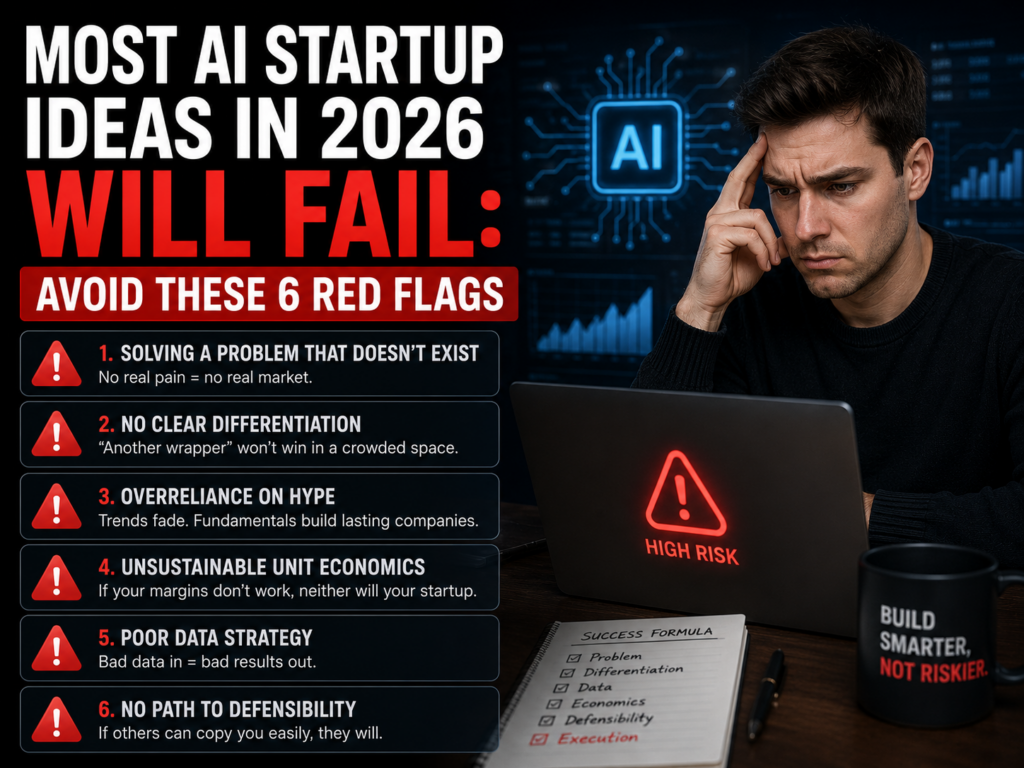
Rapid growth rarely comes without friction. AI employee startups face several structural challenges that will determine which companies survive and which collapse.
Reliability and Performance
Businesses will not tolerate AI employees that produce inconsistent results or make costly mistakes on high-stakes tasks. Startups that cannot demonstrate measurable performance against clearly defined outcomes will struggle to retain customers regardless of how compelling their initial pitch is.
Accountability and Legal Clarity
When an AI employee makes an error, who is responsible? Legal frameworks are still catching up with the technology, and early cases of AI-driven mistakes in regulated industries like finance, healthcare, and legal services will draw significant scrutiny.
Security, Compliance, and Workforce Acceptance
AI employees operate across company systems, access sensitive data, and make decisions with real consequences. Enterprises will demand robust governance frameworks before extending meaningful access. Startups that frame their products as augmenting human capacity rather than eliminating roles tend to face less internal resistance from the businesses they are selling to.
What the Future of Startup Hiring Looks Like
AI startup trends 2026 point clearly in one direction. The companies that will define the next five years are not the ones adopting AI as a productivity layer. They are the ones building their entire operating model around AI employees from day one.
Hiring decisions in these organisations will be fundamentally different. Headcount will be smaller. Roles will be more senior. The question will not be how many people does this function need, but what does this function need a human for, and what can an AI employee handle independently.
This shift in how startups think about workforce composition will have consequences well beyond the companies building AI employee products. It will reshape labour markets, redefine skill premiums, and force every category of enterprise software to demonstrate value in a world where execution capacity is no longer the bottleneck.
Why AI Employee Startups Could Define the Next Decade of Innovation
The race to build the AI workforce is already underway. The companies that succeed will not be the ones with the largest datasets or the most sophisticated models. They will be the ones that earn the trust of businesses, demonstrate consistent real-world performance, and build products that grow more valuable with every customer they serve.
For founders, investors, and operators watching AI startup trends 2026, AI employee startups represent one of the most significant category opportunities in a generation. They sit at the intersection of the largest cost centre in the global economy and the most capable generation of AI technology ever deployed.
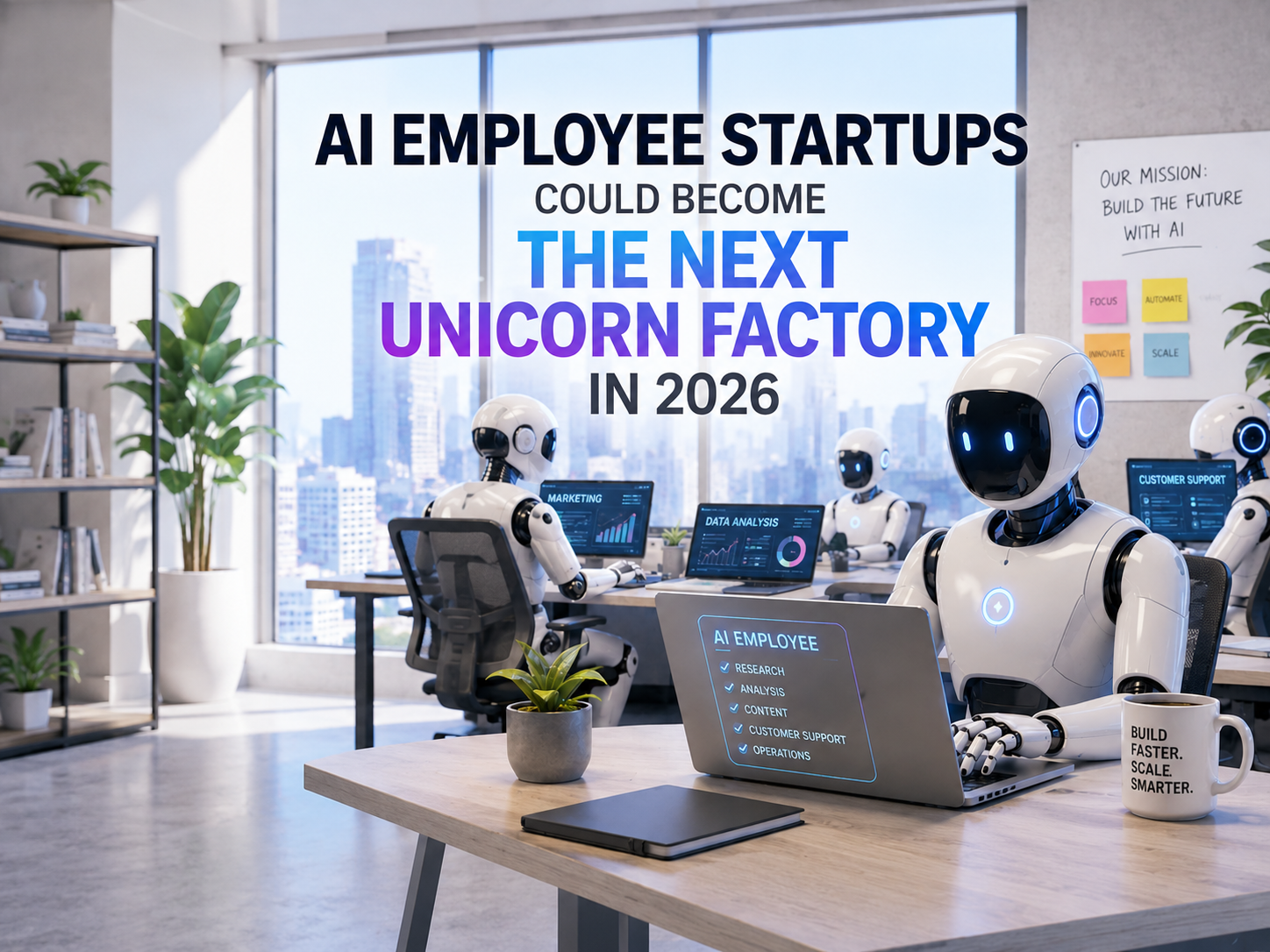
The next unicorn factory may not build a product. It may build a workforce.
Frequently Asked Questions About AI Employee Startups
What are AI employee startups?
AI employee startups are companies building autonomous digital workers that handle entire job functions independently. Unlike software tools that assist humans, these systems complete tasks like customer support, sales outreach, recruiting, and accounting on their own with minimal human oversight.
Why are investors putting money into AI workforce startups?
Investors see AI workforce startups as an opportunity to address the global labour market, one of the largest cost centres in any economy. Unlike traditional SaaS, these companies are positioned to capture a share of payroll budgets rather than software budgets, creating a significantly larger revenue opportunity.
Which industries will adopt AI employees first?
Customer support, sales development, recruitment, accounting, healthcare administration, legal operations, and e-commerce management are leading adoption. These sectors involve high-volume, repeatable workflows that map well to current AI capabilities.
How are AI employee startups different from traditional SaaS companies?
Traditional SaaS platforms require users to complete the work themselves. AI employee startups deliver outcomes directly by performing the work on behalf of the business. This changes how companies evaluate, purchase, and budget for technology entirely.
Could AI employee startups create a one-person unicorn company?
As AI systems mature across sales, operations, marketing, and support, a single founder could theoretically build and run a significant business without a traditional workforce. The concept of a one-person company generating hundreds of millions in revenue is no longer theoretical. It is becoming increasingly plausible as AI employee technology advances.
Stay Ahead of the AI Startup Revolution
Get the latest insights on AI employee startups, unicorn trends, and the future of work delivered straight to your feed